Thursday, April 26, 2007

Hugh Hewitt interviews Fred Kagan

Fred Kagan visited Iraq and says that the debate in Washington is "...lagging behind reality in Iraq.":

HH: You come back from Iraq, you see these changes, you talk with it, and then you hear Harry Reid declare the war is lost. What was your reaction upon hearing that, Frederick Kagan?

FK: It’s very disappointing. I think a lot of people, there is a lot of hyperbole, there’s a lot of exaggeration, and we really need to look this squarely in the eye, and recognize that most wars, you don’t know who’s going to win until the end. And there’s been, there were rosy optimistic scenarios from the Bush administration early on, and declarations of victory that were mistaken, and now you’ve got Democratic opponents of the war rushing to say that the war’s lost, and that it’s hopeless. And the facts on the ground just don’t support that. The war isn’t lost. We certainly can still win, and it’s really very disappointing to hear the Senator majority leader just throw up his hands like that.

Update: David Broder in the Washington Post says that Harry Reid is the Democrats' Gonzales:

On "Fox News Sunday," Schumer offered this clarification of Reid's off-the-cuff comment. "What Harry Reid is saying is that this war is lost -- in other words, a war where we mainly spend our time policing a civil war between Shiites and Sunnis. We are not going to solve that problem. . . . The war is not lost. And Harry Reid believes this -- we Democrats believe it. . . . So the bottom line is if the war continues on this path, if we continue to try to police and settle a civil war that's been going on for hundreds of years in Iraq, we can't win. But on the other hand, if we change the mission and have that mission focus on the more narrow goal of counterterrorism, we sure can win."

Everyone got that? This war is lost. But the war can be won. Not since Bill Clinton famously pondered the meaning of the word "is" has a Democratic leader confused things as much as Harry Reid did with his inept discussion of the alternatives in Iraq.

Nor is this the first time Senate Democrats, who chose Reid as their leader over Chris Dodd of Connecticut, have had to ponder the political fallout from one of Reid's tussles with the language.

Hailed by his staff as "a strong leader who speaks his mind in direct fashion," Reid is assuredly not a man who misses many opportunities to put his foot in his mouth. In 2005, he attacked Alan Greenspan, then chairman of the Federal Reserve Board, as "one of the biggest political hacks we have here in Washington."

He called President Bush " a loser," then apologized. He said that Bill Frist, then Senate majority leader, had "no institutional integrity" because Frist planned to leave the Senate to fulfill a term-limits pledge. Then he apologized to Frist.

Hat tip to Instapundit.

Update 2: Joe Lieberman is sticking to his guns:

Rather than condemning the attacks and the terrorists who committed them, critics trumpeted them as proof that Gen. David Petraeus's security strategy has failed and that the war is "lost."

And today, perversely, the Senate is likely to vote on a binding timeline of withdrawal from Iraq.

This reaction is dangerously wrong. It reflects a fundamental misunderstanding of both the reality in Iraq and the nature of the enemy we are fighting there.

What is needed in Iraq policy is not overheated rhetoric but a sober assessment of the progress we have made and the challenges we still face.

In the two months since Petraeus took command, the United States and its Iraqi allies have made encouraging progress on two problems that once seemed intractable: tamping down the Shiite-led sectarian violence that paralyzed Baghdad until recently and consolidating support from Iraqi Sunnis -- particularly in Anbar, a province dismissed just a few months ago as hopelessly mired in insurgency.

Read the whole thing. Hat tip to Pajamas Media.


Wednesday, April 25, 2007

I can't remember why I voted for him.....

Well, well and truly into Arnie's 2nd term and I really have to say I've lost any and all respect for his work as the governator after he's declared that the state will sue the EPA for not acting on the request to allow California to regulate greenhouse gas emissions. While I'm no fan of the EPA of federalism, this practice of suing it so that California gets to regulate an unproven theory the earth going through a warming trend is foolish, and a very bad use of state funds. He's pulled quite a few environmental headline grabbers lately, and I'm wondering if he's always been this way and hidden it, or he's flipped on the environmental agenda. His agenda was to clean up the fiscal mess of California, and bring it back to a well run state. Last I heard it was still in a big mess.

Bill Roggio's Daily Iraq Report 4-24-07

Read it here. Excerpt:

In Iraq's Anbar province, the Anbar Salvation Council continues to gain steam in its fight against al Qaeda. Seven new tribes have just joined the Anbar Salvation Council's political movement, the Anbar Awakening. Last week, the Anbar Salvation Council announced it was forming the Iraq Awakening, a national political party which would "oppose insurgents such as Al Qaeda in Iraq and reengage with Iraq's political process." The Iraq Awakening is scheduled to meet in May, and will be the first Sunni political party to openly oppose al Qaeda in Iraq.

Iraqi and Coalition forces continue to maintain pressure on al Qaeda's network nationwide. Yesterday, Coalition forces netted 19 al Qaeda facilitators and foot soldiers during raids in Karma, Taji and Anbar. Today, 10 al Qaeda were captured in raids in Fallujah and Baghdad.

SNP Debate

It seems that next week the Scottish National Party will be set to take over Holyrood. Via the Globe and Mail, they cite the flagging confidence that people have in Labour, and are going to a new party. While many predictions about the possible mess that the SNP will put Scotland into abound, I really am not sure how much of a shift will take place. Having spoken to an SNP MSP who belongs to my church, my view is still unclear. As a result, I will be blogging a little about what an SNP takeover may mean. Stay tuned.

John McCain officially announces he is running for President

I'm not a big John McCain fan, but this part of his speech I like:

We all know the war in Iraq has not gone well. We have made mistakes and we have paid grievously for them. We have changed the strategy that failed us, and we have begun to make a little progress. But in the many mistakes we have made in this war, a few lessons have become clear. America should never undertake a war unless we are prepared to do everything necessary to succeed, unless we have a realistic and comprehensive plan for success, and unless all relevant agencies of government are committed to that success. We did not meet this responsibility initially. And we must never repeat that mistake again.


Emphasis mine.

Patrick Lasswell and Michael Totten in Kirkuk, Part II

Patrick Lasswell at Moderate Risk and Michael Totten continue their story of Kirkuk, where a young man caught shooting off his gun while riding a motorcycle is brought to the home of General Rostam. Patrick's account can be found here:

Even before one of the most distinguished of all people in Iraq confronted the drive by accomplice, the young man was having just about the worst day of his life. The story coming out is that he gave a friend a ride on his motorcycle and the friend got stupid and started shooting. This is not an auspicious beginning to one's day, and then he got caught. Hauled away to what is obviously a big shot's house, he is getting smacked around by a police chief who is both extremely competent and seriously pissed off. Two Americans are going nuts getting him on film, one of them is even taking stills with one hand and shooting video with the other. Then in walks somebody who could give Dirty Harry lessons in being a badass and he's not taking any excuses. The smack Mam Rostam gave that kid made a sound like his brains had popped out of his head and dented the truck.


Michael Totten's account is here and continues his interview with General Rostam:

“If America pulls out of Iraq, they will fail in Afghanistan,” Mam Rostam said.

Hardly anyone in Congress seems to consider that the Taliban insurgency in Afghanistan might become much more severe if similar tactics are proven effective in Iraq.

“And they will fail with Iran,” he continued. “They will fail everywhere with all Eastern countries. The war between America and the terrorists will move from Iraq and Afghanistan to America itself. Do you think America will do that? The terrorists gather their agents in Afghanistan and Iraq and fight the Americans here. If you pull back, the terrorists will follow you there. They will try, at least. Then Iran will be the power in the Middle East. Iran is the biggest supporter of terrorism. They support Hezbollah, Hamas, Islamic Jihad, and Ansar Al Islam. You know what Iran will do with those elements if America goes away.”

Emphasis mine.

Austin Bay on Harry Reid

His latest column is up at StrategyPage:

I distinguish Harry Reid Democrats from Harry Truman Democrats. Between these two Harrys spreads a vast moral chasm that 60 years of history do not fully explain.

"Give 'em Hell" Truman possessed a large quotient of common sense, as well as the courage of his convictions.

Assess Reid for yourself. Last week, the Senate majority leader said, "Now I believe myself ... that this war is lost, and that the surge is not accomplishing anything, as indicated by the extreme violence in Iraq yesterday."

But within minutes after declaring Iraq lost, Reid returned to the mikes to backtrack. "The (Iraq) war can only be won diplomatically, politically and economically, and the president needs to come to that realization," Reid said,

It's lost, but can only be won, if if what? If "Give 'em Hooey" Harry Reid is in charge?

How refreshing if Reid had the courage of his defeatist convictions, except his convictions aren't convictions, they are postures. Reid tosses a line to Democrat defeatists, then when he discovers his mistake, edges toward reality with an oily pirouette.

Monday, April 23, 2007

Common Sense Savings: Switch to Netflix

I love movies, always have. I've spent countless hours watching and discussing movies with my friends, whether it was what was the best sci-fi movie of all time or reciting lines from Snatch or The Godfather, it's always been a favorite past time of mine. Somehow I have always managed to find time to watch movies, particularly since I am not a big fan of TV. In fact, before I got married I never had cable, relying simply on an indoor antenna and the major networks that I received - my TV and receiver was more or less a device for watching DVDs.

There was a time in my younger years when I was going to the movie theater with friends and family almost once per week, in addition to renting from the local video store. But as ticket prices went up, crowds became more unmanageable, and, in my opinion, the overall theater experience became less savory AND less safe (I distinctly remember one alarming incident where off-duty policemen had to threaten to draw guns before escorting 2 violently feuding couples from a movie we were watching) I found myself renting DVDs more often as opposed to heading to the theater. For a while this sufficed, but soon I grew frustrated with the local video store's lack of selection and concentration only on new releases.

Salvation came when my wife and I took the plunge and decided on a trial offer from Netflix. That was more than 2 years ago and we have never looked back. For those of you who just discovering this wonderful thing called the internet or who somehow managed to avoid the plethora of Netflix ads populating the internet at large, Netflix is an online DVD rental service where you order DVD rentals online and, depending on the package you order, can rent as many movies as you'd like for as long as you'd like for one flat fee. There are a variety of packages you can order, but the 2 packages my family have used are the 2-at-a-time (unlimited rentals per month, maximum 2 movies out at a time) and the 3-at-a-time (unlimited rentals per month, maximum 3 movies out at a time). Basically, you can watch a lot of movies per month, it all depends on how quickly you watch and return them, the faster you return a movie the quicker you'll get a new one.

Netflix is a good deal not only because they have a vast, diverse collection that far exceeds anything you can find at your local Blockbuster (or even Blockbuster online) but also because it will save you a ton of money over the traditional methods of watching movies.

For example, let's say you sign up for the 3-at-a-time package, which means you can have up to 3 movies at home at a time and can watch as many movies as you want provided you return them fast enough. The price per month is $17.99, let's say $18 bucks to make it simple.

Let's say you watch 3 movies a week under this plan. That's 156 movies per year at a yearly cost of $216 - which comes out to a whopping $1.38 per movie.

Let's say instead of Netflix you and your wife have a typical cable package that includes HBO and a couple of movie channels like Starz, etc. that can run you roughly $80-90 a month. On top of that, you and your wife like to go to the movie theater about once a month: 2 tickets, small popcorn, and sharing one drink will cost you roughly $25 on the low end. That's over $1,200 a year to spend on movies. If you watched 12 movies in the theater per year + another 100 or so on cable movie channels (which assumes you can actually locate 100 unique movies on cable movie packages, good luck!) - that comes out to more than $10 per movie. And let's not forget that your expensive cable package most likely includes only recent releases and repeats them over and over again, whereas with a service like Netflix you can choose from tens of thousands of movies from all over the world in virtually any genre.

It took us awhile but my wife and I gradually made the permanent move to home movie watching. We rarely go to the theater anymore and then only when we have gift certificates or the occasional invite from a group of friends or family. We quickly got rid of our expensive digital cable package and moved to basic cable + ESPN (I need my baseball). Being avid movie watchers, my wife and I calculated that we average 3.5 movies per week via Netflix, which means we devour 182 movies per year minimum:

Before Netflix:
Cable - $90/month
Local DVD Rental - $8/month (about 2 rentals per month)
Going to the movies - $25 every 2 months

Total yearly cost spent on movies = $1326.00
Total monthly cost spent on movies = $110.50

Number of movies seen per year = roughly 90

Cost per movie = a whopping $14.73

After Netflix:
Cable - $37/month
Netflix DVD Rental - $18/month
Going to the movies - $50 per year

Total yearly cost spent on movies = $710.00
Total monthly cost spent on movies = $59.17

Number of movies seen per year = 185

Cost per movie = only $3.84 per movie

Total Savings:
Per Year - $616.00 (54% reduction)
Per Month - $51.33 (47% reduction)
Per Movie - $10.89 (74% reduction)

Any questions? And with today's technology and the proliferation of home theater equipment, it's fairly inexpensive and easy to set up a very cool looking and sounding 5.1 surround home theater system. No waiting in line, no expensive food concessions, no worries about crowded theaters or unruly patrons; you can pause the movie at any time to answer the phone, go to the bathroom, or rewind to re-watch a scene again or figure out who done what to whom.

Obviously cutting out movie theaters cold turkey isn't for everyone, and even with my family it took some time, but when we sat down and crunched the numbers, not to mention the convenience of the movies coming direct to our home through the mail, it was a no-brainer.

Saturday, April 21, 2007

Our British Brothers In Arms

For a while now since I have lived in Britain, I have gained great respect for our fellow brothers in arms, the British. Since living here, I have found that most Americans view the UK forces as slightly subordinate to the US forces, and also that the US forces are superior. Nothing could be further from the truth. The British forces that work with us are just as equipped, smart, and capable as our own American soldiers. I respect our British allies, and thank them for the hard work they give to their country, their friends, and humanity.

Excerpt from Michael Yon:

The plan for Operation Arezzo was cleverly contrived. While Americans count on helicopter support for deliberate high-intensity combat here, the Brits were going into extremely hostile terrain, outnumbered, without helicopter support, relying instead upon timing, terrain, maneuverability, firepower, and sheer audacity.

In an operation that lasted over four hours, British forces killed 26-27 enemy and sustained no casualties. 5 Platoon fired more than 4,000 bullets before their guns began to cool, and about 15 of the enemy kills were accredited to 5 Platoon.

The British are planning future operations. These soldiers are so good that I have requested from British commanders to be allowed to stay longer.


Read the whole Yon post here.

Wii Rock

Came across this article, which discusses who's on top and what's happening with the big 3 consoles. No surprise, the Wii has been dominating, even though it's plagued with serious supply issues. I waited for 3 months for mine that my lovely wife got me for Christmas before cancelling my order because I got fed up. Interesting that all the articles I have read have trashed the PS3. They blame the high price, and foolish marketing decisions for the dead last Sony console's issues.

Excerpt:
"The downside of such a strong opening position is that there's little room for improvement and plenty of distance to fall, and Sony had nowhere to go but down. Meantime, as the PS3, and its diminutive (but equally black and shiny) brother the PSP continue to come up short in the software department, Nintendo and Microsoft are both quite happy to take chunks out of Sony's hindquarters. It's not hard for shoppers to come up with convincing justifications for buying a Wii or a 360, but until some better games come along, the PS3's key advantages are narrowed down to the Blu-Ray drive's movie-playing ability, and the considerable future potential of the powerful hardware. Sony's games division is not in a happy place at the moment."


read the whole thing here.

Friday, April 20, 2007

Fred Thompson: tough words on gun control

From The Fred Thompson Report:

So Virginians asked their legislators to change the university's "concealed carry" policy to exempt people 21 years of age or older who have passed background checks and taken training classes. The university, however, lobbied against that bill, and a top administrator subsequently praised the legislature for blocking the measure.

The logic behind this attitude baffles me, but I suspect it has to do with a basic difference in worldviews. Some people think that power should exist only at the top, and everybody else should rely on "the authorities" for protection.

Despite such attitudes, average Americans have always made up the front line against crime. Through programs like Neighborhood Watch and Amber Alert, we are stopping and catching criminals daily. Normal people tackled "shoe bomber" Richard Reid as he was trying to blow up an airliner. It was a truck driver who found the D.C. snipers. Statistics from the Centers for Disease Control and Prevention show that civilians use firearms to prevent at least a half million crimes annually.

-------------------------------------------------------------------

Many other universities have been swayed by an anti-gun, anti-self defense ideology. I respect their right to hold those views, but I challenge their decision to deny Americans the right to protect themselves on their campuses -- and then proudly advertise that fact to any and all.

Whenever I've seen one of those "Gun-free Zone" signs, especially outside of a school filled with our youngest and most vulnerable citizens, I've always wondered exactly who these signs are directed at. Obviously, they don't mean much to the sort of man who murdered 32 people just a few days ago.

He also has this valid point:

The statistics are clear. Communities that recognize and grant Second Amendment rights to responsible adults have a significantly lower incidence of violent crime than those that do not. More to the point, incarcerated criminals tell criminologists that they consider local gun laws when they decide what sort of crime they will commit, and where they will do so.

Hat tip to Instapundit.

Guns in the hands of Thai citizens have also served to curb terrorist attacks in a plan that has the backing of the Queen:

Soon after the beheading, the residents of Lampaya, about 800 kilometers, or 500 miles, south of Bangkok, banded together, bought 150 rifles, received weapons training from a program initiated by Thailand's Queen Sirikit, and began a 24-hour patrol system.

As a result, while surrounding villages have had about 20 killings by insurgents since the beginning of the year, the residents of Lampaya proudly report that they have had none.


Global Warming... eh, Climate Change hype

In looking for research regarding how the world has been variable and climate has changed for millennia of years, I found this article that talks about how many important data are ignored when it comes to the IPCC's little black book. In short it discusses the possibility that there might be a bigger play in the universe that causes global warming. The Sun. Really, that big mass of constant nuclear fusion creating incomprehensible heat might have more of an effect on global warming than a small insignificant amount of a gas that's a natural byproduct of life on a planet.

Excerpt:

"So one awkward question you can ask, when you’re forking out those extra taxes for climate change, is “Why is east Antarctica getting colder?” It makes no sense at all if carbon dioxide is driving global warming. While you’re at it, you might inquire whether Gordon Brown will give you a refund if it’s confirmed that global warming has stopped. The best measurements of global air temperatures come from American weather satellites, and they show wobbles but no overall change since 1999.

That levelling off is just what is expected by the chief rival hypothesis, which says that the sun drives climate changes more emphatically than greenhouse gases do. After becoming much more active during the 20th century, the sun now stands at a high but roughly level state of activity. Solar physicists warn of possible global cooling, should the sun revert to the lazier mood it was in during the Little Ice Age 300 years ago."

Read the whole thing, here.

Girls Against Boys

No, we're not going to have a post my wife would love to have a say in. This one's more on a lighter note. Seeing as all the posts have been heavy going lately, I stumbled across this site that has one of Swizstick's and my own favorite band play live. see them, here. And hey, if you like them, buy their music, here.

I especially recommend Basstation.

Thursday, April 19, 2007

Kirkuk report from Michael Totten and Patrick Lasswell

Michael Totten's report, with plenty of pics and video, can be found here:

Kirkuk’s terrorists are, my Kurdish hosts explained, mostly Baathists, not Islamists. Their racist ideology casts Kurds and Turkmens as the enemy. They’re boxed in on all sides, though, and in their impotent rage murder fellow Arabs by the dozens and hundreds. They have, in effect, strapped suicide belts around their entire community while their more peaceful Kurdish and Turkmen neighbors shudder and fight to keep the Baath in its box.

American readers may be uncomfortable by the explicitly racial nature of this description, but that’s just how it is in Kirkuk and I cannot apologize for it. Iraqis kill each other over race and religion and power. If you go there yourself you had better pay attention to who lives in which neighborhood and what they think of others. Otherwise you will not survive. I'm a bit awkwardly self-conscious about it, but race blindness is punished in Iraq with the death penalty.


Patrick Lasswell's report is here:

This is the part my wife is going to hate. Kirkuk isn't just nasty, it really is dangerous. In the month we were in Iraq, there were dozens of attacks there including one memorable day when four idiots detonated themselves inside of eight hours. The potential wealth of the area draws terror financing and organization. For perspective, imagine a VA Tech psycho attack once a week in a metro area the size of the Omaha, Nebraska. One difference is that the police and the citizens are prepared and willing to confront murderous idiots with appropriate force.

Mark Steyn: A Culture of Passivity

Over at NRO:

We do our children a disservice to raise them to entrust all to officialdom’s security blanket. Geraldo-like “protection” is a delusion: when something goes awry — whether on a September morning flight out of Logan or on a peaceful college campus — the state won’t be there to protect you.


Read the whole thing. Hat tip to Instapundit.

Wednesday, April 18, 2007

Where do the locals eat?


My hotel was of the 5-star variety and was ideally located and beautifully decorated. An internet acquaintance of mine had commented that he felt it was one of the best, if not THE best, hotels in all of Asia. I found it hard to argue with him as the service was impeccable and the rooms were roomy and well decorated with many amenities. The windows had beautiful wooden shutters on the inside that opened up to a beautiful view of the skyline and local neighborhood. I would stand at the window and watch the morning chaos of scooters and bicycles emerge as the day began. As with all such accommodations, I was grateful my company paid the bill – which they should, after all I was here on their business – because if I had traveled to Vietnam on my own I would most certainly be staying in a cheap hotel of questionable quality.


My hosts were not free for dinner that first night so I was on my own. I simply dropped my luggage in the closet and headed out for a bite to eat. Sure, I could have played it safe and expensed a fat dinner at one of the hotel’s prestigious restaurants, but what’s the fun in that? Here I was in a new city I had never been to before and would have no idea when I might be back. Working all day long meant few chances to see anything, so I decided to take advantage of the hotel’s ideal downtown location and find a local place to eat that wasn’t inhabited by tourists and businessmen.


Easier said then done. In the U.S. we have our Chinatowns, Little Kabul, Little Saigon, Little Italy, etc. In some places, like Oakland or San Francisco, the Chinatowns’ are large enough and offer a diversity of businesses (along with huge Chinese/Asian populations) that an immigrant from China could completely live and survive within their own culture, never having to fully learn the language or fully involve themselves in mainstream American business and culture. The same thing is true of what we call the expat culture overseas; westerners tend to congregate in mostly foreign occupied housing, go to English speaking international schools, shop at English speaking western-style supermarkets, etc. I saw the same thing when I lived in Hong Kong, where entire luxury apartment buildings, clubs, restaurants, supermarkets, and even office buildings catered almost exclusively to expats and foreigners. I knew of one guy who had lived in Hong Kong for over 10 years and couldn’t speak more than a few words of Cantonese and couldn’t remember the last time he had ever ventured off of Hong Kong island, not to mention his own general neighborhood. He worked in an international company with other foreigners and English speaking local staff, ate with colleagues and friends in western-style restaurants, bought his food on the weekend from the local international supermarket located within walking distance from his home, cooked and ate the same food he ate in his home country and mostly hung out with his foreign neighbors and friends. He basically lived life no differently then when he was at home. There’s certainly nothing wrong with that, he was a great guy who just didn’t fancy the Chinese culture or cuisine and felt more comfortable living in his “own environment”.


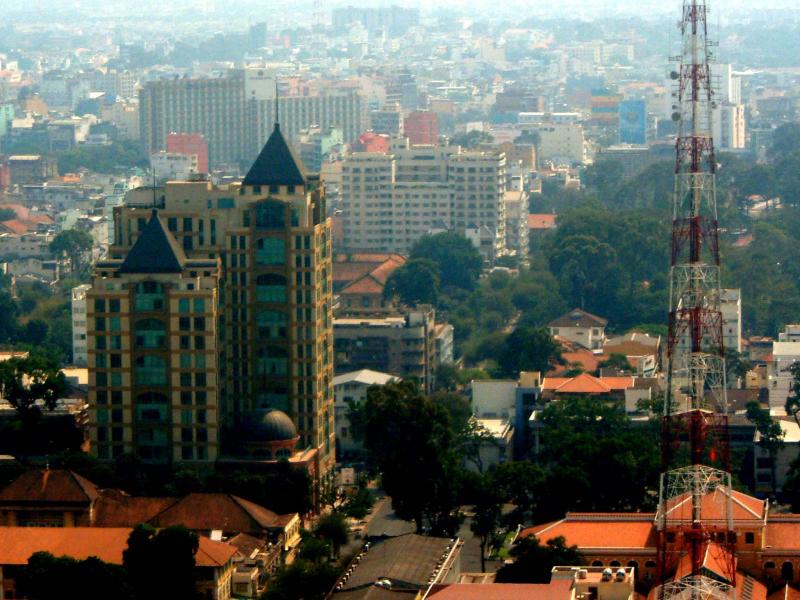
Downtown Ho Chi Minh City is no expat village, but since it’s mostly a collection of international hotels, multinational office buildings, and tourist attractions it certainly tends to attract a mostly expat clientele. While there were plenty of locals bustling about, there was also an equal amount of, if not more, foreigners milling about, particularly at dinner time as employees were leaving the offices after a day’s work and heading home. In this environment, finding a nice “local” restaurant turned out to be impossible. I first wandered around the streets just to get a feel for the neighborhood, and I am a fast walker and enjoy exploring, so I covered a lot of ground. There were plenty of restaurants, but they catered entirely to expats and foreigners – Italian restaurants, German restaurants, Japanese restaurants, French restaurants. There were some restaurants that claimed to actually serve local Vietnamese cuisine, and perhaps they did, but when I looked through the windows all I saw where western faces looking back at me – which I took as a bad sign, considering I was in Vietnam!


Perhaps some travelers like the “comforts of home” so to speak but when I travel to a new destination I want to try something new, experience at least a taste of local life, and what better way to do it then to try some local cuisine, preferably in a local setting and not chock full of tourists.


Another thing I noticed was the prices. This was Vietnam, after all, a still developing country where the GDP per capita was only $3,100 and food supplies were therefore relatively cheap, comparably speaking. Yet the prices I was seeing on menus were more than I would pay back home in the U.S. It didn’t affect me directly since I could expense it with my company, but normally when I travel to Asia I tend to spend less eating out then back at home.


I finally gave up trying to find out where the locals ate and settled on a Thai restaurant, of all things (having just traveled from Thailand). There were ZERO locals in the restaurant, the only Vietnamese people in there were those that worked there and they all spoke English. Various couples and people from a multitude of origins populated the restaurant. There were some Indian people there, plenty of Caucasians, and a handful of Asians who appeared to be from either Singapore or Hong Kong. I ordered an herb tea, an appetizer, and one small noodle dish: total bill, including tip? USD 20.00. The food was certainly good, but the same meal in Thailand would have cost less than half as much.


Walking back to the hotel I kept getting bothered by bicycle tour guides, where you sit in a little cab pulled by a bicyclist. Other vendors also bothered me with wares or service, and like Bali they were very insistent. I was polite at first, but unlike Bali they didn’t leave me alone. So I finally ignored them and just kept walking faster. At one point I had like 3-4 guys hurriedly following me, all shouting at once for my business – I think I would have been treated differently had I not been alone – perhaps families or groups were bothered less, but it’s a little unsettling to be in a foreign city in the dark at night, walking alone, and having people accost you aggressively for business.


To be continued….

Which is why I plan to build my next computer.......

Walt Mossberg comments over at Personal Technology:

I'm distinguishing these programs, sometimes called "craplets," from the full-featured, built-in Sony software meant to enhance the computer, or from entire, useful programs Microsoft builds into Windows, such as music and photo organizers.

On my new Sony, there were two dozen trial programs and free offers. The desktop alone contained four icons representing come-ons for various America Online services, and two for Microsoft. The start menu and program menu had more items that I neither chose nor wanted. Napster, a music service I don't use, was lodged at the lower right of the screen.

The worst was a desktop icon called "Watch Hit Movies Now!" This turned out to be four full-length films from Sony's movie studios, which the company had preloaded onto my computer at the cost of more than four gigabytes of precious hard-disk space. But they aren't a gift. If you want to play them, you have to pay Sony.

Then there was the security-software mess. I signed up for a 60-day free trial of Symantec software that Sony offered. This required multiple rounds of scary warnings, scans and updates -- on the first day of using a new machine. Plus, when I tried to use a feature that stopped some unwanted programs from loading, I was forced to launch a second, somewhat redundant, security program from Microsoft.

On top of this, Sony informed me it had 21 different software updates available for my brand new laptop.

Hat tip to BizzyBlog.

Estonia flat tax = booming economy

Yet another story about a developing country's success with a flat tax system - the Cato blog links to a story by John Stossel over at TownHall:

Estonians need an average 10 to 15 minutes to file their income taxes. Most do it without leaving their desk: 84 percent file online. … Unsurprisingly, Estonia is booming. The former Soviet republic used to be poor, with an average income 65 percent below its European neighbors. Today, Estonians are almost as rich as their neighbors, and their economy is growing more than 11 percent a year. Corporations like a tax system that is low and simple, too, and that leads them to do more business in flat-tax countries. American companies such as Microsoft, Colgate, 3M, Bristol-Meyers Squibb, and Johnson & Johnson opened businesses in Estonia after the flat tax was adopted. Twelve years ago, foreign investment in Estonia made up only 5 percent of GDP, but today, it’s up to 20 percent.

Monday, April 16, 2007

Tax payer funded luxury vacations

From Reason.com:

Thompson’s office said he toured the Caribbean because he now chairs the Homeland Security Committee and wanted to see vacation hot spots to “examine border security and port security.” Three other members of the delegation also brought along their spouses.

[...]

At the Caneel Bay resort, where room rates reach $1,100 per night, the spokeswoman said Thompson and his wife paid the “government rate.” But, according to the reservations department, Caneel Bay doesn’t “offer any government rates.”

[...]

The Caribbean trip led by Engel, who is chairman of the House Foreign Affairs Subcommittee on the Western Hemisphere, explored the “best practices for emergency disaster relief” and energy policy, according to his office.


Hat tip to Instapundit.

Traffic, Traffic, and more traffic......

Bangkok, Thailand is famous for its bumper-to-bumper traffic; it makes Los Angeles traffic look like a cake walk. But nowhere I have been can compare to the horrid mess that is known as Ho Chi Minh City traffic. There is only word to describe it: chaos. Make that two words: utter chaos. Ho Chi Minh City is a city undergoing massive development on a very fast scale along with rising incomes and a growing middle class. The preferred mode of transport in and around Ho Chi Minh City is the scooter. I had heard that scooters were prevalent in Vietnam but nothing could have prepared me for what I experienced. Scooters were everywhere, going everywhere, and in every direction, in complete disregard to the right of way, signage, and basic road laws. In Ho Chi Minh City, everyone wants to go all the time regardless of direction, traffic flow, or traffic cops. At certain intersections and especially during rush hour traffic cops play a losing battle trying to direct the mass of scooters, motorcycles, buses, and cars and everyone tends to ignore them.

Another problem is that once you get outside of Ho Chi Minh City proper the quality of the roads declines considerably. Whereas the airport area and downtown look like just another bustling, developing big Asian city, once you venture far enough away things start to take on a decidedly worn feel. Nicely paved and divided streets turn into potholed sloppily paved streets with gravel sidewalks. Occasionally the pavement would end and we would find ourselves on dirt roads for awhile occasionally cruising through deep mud holes before finding a patch of pavement again.


Before my trip I had planned to visit a number of businesses located in what I considered close proximity to Ho Chi Minh City. Then my agent had informed me that it would be very difficult to visit so many factories in such a short period of time and scaled things down. I accepted the scaled down version but insisted on keeping a couple of key factories on the list, insisting that we find a way to fit everyone into the schedule – after all, none of the factories were more than a 10-15 miles away from each other. My agent patiently explained to my ignorant self that the transportation infrastructure in Vietnam left much to be desired. No worries, I thought, I had seen some dodgy roads here and there in my time – how bad could it be?


Bad. Really bad. From the airport to the first factory was only about 20 miles – and it took us over an hour. As mentioned above, crowded city streets gave way to single lane, roughly paved roads with gravel sidewalks. These in turn became pot-holed nightmares with the occasional dirt patch thrown in. At times we turned completely off the main road and were cruising on rough dirt roads along with bicyclists, water buffalos, carts, and pedestrians. I have no idea what war-era Vietnam looked like, but I can’t imagine much has changed outside of Ho Chi Minh city. Lots of bicycles, scooters, and pedestrians driving down narrow, poorly maintained roads, with rickety storefronts facing the streets with faded residences upstairs; the occasional rice paddy or tended field, carts being pulled by water buffalo, and old communist party murals and pock-marked billboards from the war era. Occasionally you’d even see the rusted hulk of some military vehicle or other war-era relic, overgrown with weeds.


Eventually we made it to the first factory, which was a sprawling facility in the middle of the jungle, a good 20 minutes from what passed as the main road. I’ll spare you the details of factory visits and business meetings, but suffice it to say there are huge disparities between the fairly new private ventures and the old-school government owned and operated factories.


The private facilities were often bustling with activity, well organized, with many modern manufacturing procedures and processes in place. Government owned factories tended to be less organized, less efficient, and simply appeared as if they had seen better days. They tended to boast official party connections with numerous certificates from party organizations and multiple pictures of prominent party members. It’s not that these factories weren’t producing – they were, and they certainly worked hard, but they have some catching up to do if they want to be the equivalent of the private market.


Another thing I noticed, which I am sure will rankle the true communists out there, is that the employees in the non-government run facilities had a safer working environment and were often paid better and treated better than their comrades in the government operated factories (Although they also worked harder, and faster too). There seemed to be a lot of down time at some of the government run facilities. At one government run facility I went to they were constantly boasting of their party connections and that they were better than all the other factories in the neighborhood – not because of some perceived competitive advantage or that they had some kind of unique product or manufacturing process, but simply based on their party affiliation. There was no logic to it, but they seemed to believe that they were superior simply because they were more strongly connected to the party. Every time I questioned them about what I saw were deficiencies that needed to be improved it was dismissed with a wave of the hand and a pronouncement that their close party ties would solve everything.


At lunch time my colleagues appeared visibly nervous and began chatting furiously with each other and the driver in Vietnamese. We got out to the main road and made several u-turns and went down a few side streets before I finally asked them what was wrong. They smiled shyly and said they didn’t know where to eat. This was officially “the sticks” by Western standards and they didn’t know where to eat that would be deemed “suitable” by my Western mind. I politely informed them that I considered myself a world traveler who relished living and eating with the locals as opposed to staying in the sanitized picture of 5-star hotels and business restaurants that catered entirely to foreigners. They looked at me skeptically – Was I saying that I would be comfortable eating at some roadside restaurant with the locals? Absolutely, in fact I preferred it. They found my reply humorous and, obviously relaxed now, quickly gave the driver some directions.


I found myself at a small, airy, very clean open air restaurant with high ceilings and numerous fans to keep the hot, muggy air moving. The restaurant staff froze when they saw a white face and stared at me, standing there in slacks, a button-down shirt and tie, eyes wide open with surprise. My colleagues chuckled and I got the impression that maybe, just maybe, this restaurant rarely served foreigners. I was laughingly asked what I wanted to eat as the menu was completely in Vietnamese – no surprise of course. They then told me we would be eating a very typical local lunch.


It was nothing I hadn’t eaten before in Vietnamese restaurants in the U.S., but the way it was served was much different. Basically we ate spring rolls, but unlike in the U.S. where they come to the table all wrapped up and on a plate, here they bring you several plates of flat wraps and a huge platter of ingredients and sauces. You picked the vegetables and other ingredients you wanted to eat, wrapped it up, and chowed down. We also had small bowls of noodle soup as well. It was refreshing and delicious. The restaurant was meticulously clean and before eating they had distributed plastic-sealed sanitary wipes to clean our hands before eating. My colleagues were pleased that I enjoyed the meal and openly relieved that they didn’t have to drive around in circles for an hour trying to find a “foreigners” restaurant.


At the end of the day I checked into my hotel which was conveniently located in the heart of Ho Chi Minh City in close walking distance to all the major attractions and the main business district of the city.


To be continued…….

UK Doctors advise against a career in medicine

Citing "terrible" morale.

The survey, conducted by Hospital Doctor magazine and the website Medix, asked doctors if they agreed with Patricia Hewitt, the Health Secretary, when she said 2006 had been the best year for the NHS. Nearly 90 per cent disagreed.

One doctor told the survey: "As more hospitals try to balance books by sacking staff, the remaining staff are having to pick up the slack, resulting in more mistakes being made. Morale is at an all-time low and getting worse."

Stephen Campion, the chief executive of the Hospital Consultants and Specialists Association, was "saddened" by the results of the poll.

"Traditionally, many doctors have followed in their parents' footsteps and increasingly we are hearing doctors saying they wished they hadn't recommended a career in medicine to their children.

"This is indicative of the extreme frustration and low morale hospital doctors are feeling."

A spokesman for the British Medical Association said: "The survey shows how doctors believe constant Government reforms are taking them further away from their vocation - to treat patients."

Emphasis ours. Big hat tip to BizzyBlog.

Bill Roggio's Daily Iraq Report 4-16-07

Good and bad news from Bill Roggio on Iraq, noting that U.S. and Iraqi raids over the past 48 hrs have resulted in the capture of 129 insurgents, including a number of Al Qaeda members.

Iraqi security forces, with the help of the Anbar Salvation Council, killed Ahmad Hadid, the leader "Islamic State in Fallujah," and Ibrahim Keitan, Al-Qaeda's military coordinator in Al-Anbar. An American military intelligence official tells us Ahmad Hadid is the brother of the notorious Omar Hadid, Abu Musab al Zarqawi's right hand man in Fallujah until he was killed in Novermber of 2004. Thirty-seven al Qaeda were captured in Fallujah, 6 in Amiriya and another 11 were captured along the Euphrates River Valley.

Coalition raids in Taji, Mosul, Baghdad and Amiriya netted 17 al Qaeda, including the "al-Qaeda emir of Rusafa and former vehicle-borne improvised explosive device cell leader." In Basra, British troops killed 8 members of two roadside bomb teams as they were in the process of planting IEDs. On March 11, Iraqi police captured 2 members of a cell thought to be "responsible for planning and building improvised explosive devices containing chlorine."


On the bad news, Al Qaeda also carried out two successful suicide bombings.

A suicide car bomber murdered 47 Iraqis and wounded scores more just several hundred yards from the Imam Ali mosque in Karbala, while another suicide car bomber destroyed a bridge in Baghdad. The Jadriyah bridge, which crosses the Tigris river, is the second bridge attacked by al Qaeda in Iraq just this week. Ten were killed and fifteen wounded in the Jadriyah bridge bombing.

Under the readership of Abu Ayyub al-Masri Al Qaeda in Iraq is proving agile in its ability to switch targets in Baghdad while continuing to strike at sectarian fault lines outside the capital. Prior to this week, al Qaeda's last major bombing inside Baghdad was in a Shia market on March 29. With security ramping up inside Baghdad, markets appear to have become tougher targets. The attack on the bridges will at the least increase the security, and may force the closure their closure.

Australians send 1,000 more troops to Afghanistan

After insisting with the mostly European ISAF that their troops would be "...under Australian national command and interpret their rules of engagement in an Australian way."

Via The Belmont Club who comments:

The Australians know what the Europeans should soon rediscover: the danger comes from within one's self; that there are none so lost as those who have misled themselves.

More appeasement from the Western World

As UK teachers refrain from teaching about the Holocaust for fear of offending Muslim students:
The findings have prompted claims that some schools are using history 'as a vehicle for promoting political correctness'.

The study, funded by the Department for Education and Skills, looked into 'emotive and controversial' history teaching in primary and secondary schools.

It found some teachers are dropping courses covering the Holocaust at the earliest opportunity over fears Muslim pupils might express anti-Semitic and anti-Israel reactions in class.

The researchers gave the example of a secondary school in an unnamed northern city, which dropped the Holocaust as a subject for GCSE coursework.

The report said teachers feared confronting 'anti-Semitic sentiment and Holocaust denial among some Muslim pupils'.

It added: "In another department, the Holocaust was taught despite anti-Semitic sentiment among some pupils.

"But the same department deliberately avoided teaching the Crusades at Key Stage 3 (11- to 14-year-olds) because their balanced treatment of the topic would have challenged what was taught in some local mosques."

Fred Thompson on taxes

Over at the WSJ:

The results of the experiment that began when Congress passed a series of tax-rate cuts in 2001 and 2003 are in. Supporters of those cuts said they would stimulate the economy. Opponents predicted ever-increasing budget deficits and national bankruptcy unless tax rates were increased, especially on the wealthy.

In fact, Treasury statistics show that tax revenues have soared and the budget deficit has been shrinking faster than even the optimists projected. Since the first tax cuts were passed, when I was in the Senate, the budget deficit has been cut in half.

Remarkably, this has happened despite the financial trauma of 9/11 and the cost of the War on Terror. The deficit, compared to the entire economy, is well below the average for the last 35 years and, at this rate, the budget will be in surplus by 2010.

Perhaps the most fascinating thing about this success story is where the increased revenues are coming from. Critics claimed that across-the-board tax cuts were some sort of gift to the rich but, on the contrary, the wealthy are paying a greater percentage of the national bill than ever before.

The richest 1% of Americans now pays 35% of all income taxes. The top 10% pay more taxes than the bottom 60%.

Hat tip to Instapundit.

Flat Tax: If they can do it, why can't we?

If lesser developed nations like Montenegro, Albania, and East Timor can implement a low flat tax, why can't we?

Montenegro is moving to a 15% flat tax on personal income that will gradually be lowered to 9% by 2010. Albania's will be 10%. East Timor seeks to set itself up as a free-trade nation (much like Hong Kong and Singapore) with income tax rates between 5-10%.

Update: Russia's politicians reject progressive tax scheme, keeping the current flat tax system in place:

Russia’s flat tax has been remarkably successful. Growth is reasonably strong and tax compliance has improved. Indeed, inflation-adjusted personal income tax revenues have been growing at double-digit rates.

Thursday, April 05, 2007

Nanny state has a voice now

Britain is already one of the most watched nations on earth and now "talking" CCTV cameras are to be installed in 20 areas across the country.

The loudspeakers will allow CCTV operators to bark orders at people committing anti-social behaviour.


Via The Telegraph UK

Competitions are being held at schools in many of the areas for children to become the "voice" of CCTV cameras, Mr Reid said.

"Local communities are rightly fed up with littering and anti-social behaviour - they want to remind people about what is, and is not, respectful behaviour," he said.

"By funding and supporting these local schemes, the Government is encouraging children to send this clear message to grown ups: act anti-socially and you will face the shame of being publicly embarrassed."

According to recent studies, Britain has 4.2million CCTV cameras - one for every 14 people in the country - which amounts to 20 per cent of the global camera total.

All emphasis ours. Cameras watching your every movement in public? Children encouraged to rat on their parents for "anti-social" behavior? And who defines what is "anti-social"? If it sounds like some kind of awful Orwellian nightmare that's because it is.

Hat tip to Pajames Media.

Washington Post editorial slams Pelosi visit to Syria

Excerpt:

The really striking development here is the attempt by a Democratic congressional leader to substitute her own foreign policy for that of a sitting Republican president. Two weeks ago Ms. Pelosi rammed legislation through the House of Representatives that would strip Mr. Bush of his authority as commander in chief to manage troop movements in Iraq. Now she is attempting to introduce a new Middle East policy that directly conflicts with that of the president. We have found much to criticize in Mr. Bush's military strategy and regional diplomacy. But Ms. Pelosi's attempt to establish a shadow presidency is not only counterproductive, it is foolish.


Hat tip to Instapundit.

Update:
The always brilliant Cox and Forkum:

Saturday, March 24, 2007

I think he's a might ticked off

An emotional and what seems to me angry post from Michael Yon, who seems to be feeling heat from some general who wants him out of Iraq. Michael doesn't mince words, and has resorted to short fast dispatches to get the word out fast. Excerpt on his view of the army's attitude:


"For a military that is the first to gripe about not getting enough press–in a kind of war where the press can determine the outcome–it seems fairly obvious that the first step would be to at least make sure there is a place for the press to work. If this were a few months into this war, I could understand it, but to not even be at square one this far in? "

and:

"They want the press on a short leash, even at the expense of the life of a soldier."

enjoy, read the whole thing, here.

Tuesday, March 13, 2007

Gore Vs. Reality

We're finding a little more skepticism now, or at least calls to calm down a bit to the right environmental Reverend Al Gore, some even saying that the shrill voice of calamity is muddying the waters and not helping matters.

Excerpt:

(The IPCC) estimated that the world’s seas in this century would rise a maximum of 23 inches — down from earlier estimates. Mr. Gore, citing no particular time frame, envisions rises of up to 20 feet and depicts parts of New York, Florida and other heavily populated areas as sinking beneath the waves, implying, at least visually, that inundation is imminent.

(emphasis and insert added)

Read the whole thing, here.

More, here.

and, here.

A scientific petition with 17,000 signatures against Gore's claim of disaster, here.

We're being swindled

Update: Google video moved it, but you have to go through other sites to find it. See it here

Update: Google video has mysteriously disappeared. sorry. I don't know why.

I've been agreeing with the above statement for years, in regards to global warming. What I was reading in the news, and seeing on TV, and seeing on the internet did not add up. The more I looked, the worse it got. I watched this last night, and it answered a lot of questions. Funnily enough, it even said things I'd begun to observe, but I really don't think it has caught on yet, namely that Environmentalism is becoming a religion. Some people even compare Al Gore to Jesus Christ. I'm not even going to go there on the extreme issues with that one. If you can find a way to watch the documentary, watch it. It's very good. Even Patrick Moore, Co founder of GreenPeace, speaks out against it, saying that environmentalism has been flooded with extreme left pro Marxist anti capitalist poltitical activists who learned how to use green language to their advantage. When people like that talk, I start to listen.
Google video, here.

Monday, February 05, 2007

Anyone else worried?

I've been worried for some time that the IPCC's latest report, due out soon, will cause a serious power frenzy by the higher ups. It's begun, and my sentiment is mirrored exactly here. We need to start uniting togther to stop the frenzy from getting further along. Any ideas on what we can do?

Monday, January 29, 2007

Watching out for the little guy

Just caught this floating around the blogsphere, and all I gotta say is, John Edwards really does look after numero uno. 28,000 square feet? Wow. And I'm living in a 650 Sq foot. 3 Bed Apartment. Of course, there's the rumours regarding a few shady tax breaks as well.

Warner Resolution Action

For anyone out there who is a bit annoyed (ie: incensed) at the extreme backbiting and partisanship that encompases the Warner Resolution, NZBear and Hugh Hewitt have a way of fighting back. I am posting an email they sent me of what we can do to help undermine the virtual sabotage of the "surge" of 20,000 US troops to Iraq. Here goes:

Please tell the candidates in the ’08 cycle especially – Alexander, Collins, Coleman and Smith and would be presidential nominees McCain and Brownback — that a vote for the Warner resolution is the end of support for them and the NRSC.

Senator Alexander’s phone: (202) 224-4944. His e-mail form is here: http://alexander.senate.gov/index.cfm?FuseAction=Contact.Home

Senator Brownback’s phone: (202) 224-6521. His e-mail form is here: http://brownback.senate.gov/CMEmailMe.cfm

Senator Coleman’s phone: (202) 224-5641.His e-mail form is here: http://coleman.senate.gov/index.cfm?FuseAction=Contact.ContactForm

Senator Collins’ phone: (202) 224-2523. Her e-mail form is here: http://collins.senate.gov/public/continue.cfm?FuseAction=ContactSenatorCollins.Email&CFID=39113496&CFTOKEN=99427497

Senator McCain's phone: (202) 224-2235. His campaign e-mail form is here: http://www.exploremccain.com/Contact/

Senator Smith’s phone: (202) 224-3753. His e-mail form is here: http://gsmith.senate.gov/public/index.cfm?FuseAction=Contact.Home

Senator Voinovich's phone: (202) 224-3353. His e-mail form is here: http://voinovich.senate.gov/contact/index.cfm

The GOP leadership, which need to announce that no resolution will voted on that encourages the enemy, and that includes the Warner resolution or any cousin of the Warner resolution:

Minority Leader Mitch McConnell’s phone is (202) 224-2541. His e-mail form is here: http://mcconnell.senate.gov/contact_form.cfm

Minority Whip Trent Lott’s phone is (202) 224-6253. His e-mail form is here: http://lott.senate.gov/index.cfm?FuseAction=Contact.Email

Senator Jon Kyl’s phone is (202) 224-4521. His e-mail form is here: http://kyl.senate.gov/contact.cfm

Senator John Ensign’s phone is (202) 224-6244. His e-mail form is here: http://ensign.senate.gov/forms/email_form.cfm

Write them, tell them what you think, and how that them turning their back on the Iraq war and our troops for a few votes is wrong.

Sunday, January 28, 2007

I Love Cars

I often get criticized for my views on cars, driving, fuel prices, engine size, fuel mileage, but my views on it are far from based on ignorance. I've often seen trends, and views, and gone to see whether they were true or not. When I was in high school, I took auto shop, and we were asked to present a report on alternative fuel vehicles, and at the time, living in California, Electric cars were the big push by the media and "greenies". My report ended up being in favor of conventional cars, for many reasons, and if anyone asks, I will post them, but this post isn't the right time. I ran across this today, and it really illustrated the falsities of the "conventional" wisdom that gets bandied around the media.

I've always believed that America has a love affair with the car, and that is proven by the fact that there are vast amounts of improvements, upgrades and the like to customize your car practically indefinitly. Living in the UK, a supposed "green" country, with laws to try and "encourage" public transit and get people out of cars, driving is basically catching up to US levels, and customizing and modifications have caught on in a big way. Not like these, where the US essentially dominates, but what I like to call the "boy racer" scene, with many mods also being made to family cars, like the Ford Mondeo, with even a big site dedicated to the car.

This has shown that cars are still the preferred method of travel, and it doesn't take a brain surgeon to discover why. It's fast, cheap, easy, and direct to your door. With that in mind, why shouldn't we drive? The article I linked to shows the top 5 myths in regards to pollution and how we're destroying the world. I agree with pretty much every point, and it reflects my own observations in the world.

I especially liked the last point, in regards to what the real impact of driving less means. In the past 10 years I've seen environmentalism shift from a concern for the environment to how much power and influence can they wield. The driving less cars issue, with the resultant burning less fuel issue fails simply because it'd implausible. In myth 5 the author talks about how we would be better off dealing with the effects of global warming (which will most likely be far less severe than scientists have claimed).

This becomes a valid argument because:
A: Global warming will not stop or slow down because we burn less fuel.
B: Developing countries such as China and India would destroy their fragile economies, and that would not be good because historically it is countries with strong economies that have the most environmentally sound policies. In short, they can afford it.
C: If those economies did collapse, any environmental gain would be lost due to billions of people being totally unconcerned for the environment because they are worried about their very survival, though I am sure some people would enjoy that.
D :The solution to bring the world out of the crisis of global warming is to bring the countries who create the most pollution into a stable and positive economy that cares about the envrionment and has the spare cash to do so.

The result of artificially jacking up fuel prices through taxes, and raising the cost of using a car to horrifically high levels does nothing but increase the gap between rich and poor. The poor can't afford a car and are forced to use expensive, inefficient and dirty public transport, and the rich sit happy in their luxury cars burning fuel that they can afford to burn. The real squeeze ends up on the middle class, essentially forcing them to sacrifice other things to run increasingly expensive basic vehicles. And as has been seen in Britain, the amount of cars on the road is rising, not due to a disregard for the environment, but becasue the standard of living is rising and they can afford it. Which basically shows that when we can afford to pay for environmentalism, we are willing to do so.

Which begs the question, what's a better way to spend the funds raised as a result of the increased cost of awareness? Is it through spending in government with no oversight (through high fuel and road taxes) ? Or is it better to funnel the money through private companies who make use of environmental laws to create companies, jobs, and ultimately, a much cleaner and safer environment. I vote the latter.

Wednesday, January 17, 2007

Hot Air TV does Iraq


Absolute must watch webTV

As Glenn Reynolds said today: "Folks at CNN, et al., should be trembling."

Be sure to read Bryan Preston's written report as well: "So whether we win ugly or pretty, we have to win. And we can."

(Hope Hot Air doesn't mind me using one of their photos)

Tuesday, January 16, 2007

Welcome to Saigon! Er...Uh...I mean Ho Chi Minh City


I was excited to go to Vietnam, a country I had always wanted to go to and see how things had changed since they opened up to the world and the U.S. normalized relations with them. I had heard mostly positive reports from business colleagues and some of my more adventurous travelling acquaintances, which only served to fuel my excitement in going. Unfortunately, my trip was all work and no play, with only half a day of free time. However, I was given an outline via e-mail of a great half day walking tour based on my hotel location from a friendly stranger which proved to be just perfect based on the amount of time I had.

Despite normalizing relations with Vietnam and their booming economy, there are no direct flight options to Vietnam, although most of the Asian air carriers have connecting flights to Ho Chi Minh City and Hanoi. I had already flown into Thailand so it was an easy 1 hour flight from Bangkok to Ho Chi Minh City - they are pretty close. I took Thai Airways from the brand new Suvarnabhumi International Airport in Bangkok and was told to get there early. Boy was I glad I did. The new airport in Bangkok is massive and that goes double for the check in area for Thai Airways. Not that its size helps much, the line to check into Thai Airways - for both Int'l and Domestic flights - ran out the door and down the sidewalk. Despite having rows of check-in counters available the staff simply couldn't check people in fast enough. Worse, there was no way of knowing which row of counters you had to go to for your flight until you managed to get through the door and into the terminal. After wasting an easy 30 minutes inching forward in this long line, I finally saw a sign that indicated check in for business class passengers (thankfully my company pays for business class tickets when travelling overseas). Once I got there it was smooth sailing and I was on my way to the gate.

However, once I got to the gate they announced that the flight was delayed (I apologize to my proud Thai friends but this is quite normal for Thai Airways, delays are too frequent and common). So despite arriving early and sweating in a long line I was destined to wait for Thai Airways to get their act together. Eventually, they herded us onto a bus on the tarmac where we drove around in what seemed like circles for 15 minutes before getting to our plane. (For your information, Thailand opened the new airport before it was 100% complete just to save face since it was already a couple of years late. Because of this, construction is still going on in various sections of the airport and not all the gates are available for the number of flights being handled by the airport). I settled down in my seat and closed my eyes and away we flew. It seemed we barely had time for a quick meal and a drink before we were landing in Ho Chi Minh City.

For those of the Vietnam War-generation, Saigon is the only name they know for Vietnam's largest, bustling city. Even the 3-letter airport code - SGN - has remained the same. But after the Vietnam War was ended, the government renamed it Ho Chi Minh City in honor of their beloved leader. For some people my parents age and who lived through that era it will always be known as Saigon and in fact many of the locals still refer to it this day as Saigon. However I found that many of the younger people did refer to it as Ho Chi Minh City, particularly when talking to a foreigner.

The airport is old and dated but it should be noted that Vietnam is making significant investments in transportation infrastructure and a new airport was hastily being constructed next to the old one. Althought the structure was quite dated and obviously unable to keep up with the number of flights and passengers being handled, everything was kept quite clean and orderly. While both the outside and inside looked as if they hadn't been changed much since the 70's, it was conspicuously clean and well organized. Long lines formed at immigration and when I got closer I could see why. Vietnam is one of the very few countries I have been to where the immigration control officers take their job seriously. These guys must have looked at my passport, their computer screen, my face, and back the passport again a dozen times over many long minutes before finally stamping my visa and passport and allowing me to go on my way. The baggage claim area was neat and orderly with uniformed government airport officers keeping close watch on everything. The AC was surprisingly in good order.

The official Vietnamese currency is the Dong and it's close to worthless. Up until a few years ago everyone openly accepted US Dollars in addition to Dong - in fact, even today, you can still find prices for some things in Dollars and not Dong. However, several years ago the government clamped down and mandated that goods and services must be tendered using the official Dong currency. The current value of the Dong is about 16,700 to the dollar, although it fluctuates widely and the rate you get from banks and hotels can vary from about 15,000-16,000 and is subject to change by the day. Because of this, Vietnamese use very few coins, with almost all transactions being done using paper money of large denominations. I had promised a friend of mine to pick up some Vietnamese coins and the only way I could do it was to beg a restaurant to give me a portion of my change in coins instead of paper.

I changed a small portion of money at the airport, figuring I could hit an ATM or bank later to exchange more. Besides, I was there on business and would be in meetings all day every day so there was little chance of me spending a lot of money.

Walking outside the heat was nigh unbearable. That sounds hard to believe coming from hot and humid Bangkok, but for those who know how hot Bangkok is believe me when I say that Ho Chi Minh City is even hotter! The humidity is worse than almost anywhere else I have been and the temperature several degrees hotter than Bangkok. I squinted my eyes in the bright sunlight outside as I looked for my agent who had come to pick me up. I noticed a bright smiling young man who looked as if he could have passed for 19-20 yrs old oustretching his hand and greeting me by name. His English name was James and it turns out he was indeed young, although more like 25-26 than 19-20. Again, like so many other Asian countries I had been to, it seems as if the young people are "in charge" just about everywhere. I met the other people from my agent's office who would be accompanying me the next few days and it turns out I was the oldest in the group at 33 yrs of age and the only one married! We quickly set off for our first factory visit and meeting in a mercifully cool SUV.

To be continued.........

Monday, January 15, 2007

Bali, Indonesia wrap-up

Meant to post this a very long time ago (I finished my trip to Bali way back in May 2006 - talk about procastinating!) but just got back from Costa Rica and before that spent a month in Vietnam and Thailand, so I have a lot of posts coming up about my recent travels. That and keeping up with my other work as well as taking care of my rapidly involving and active 11 month old has made it difficult to keep up with the blogging. So this post will be brief so I can begin my posts on Vietnam.

Bali is one of the most beautiful places I have ever been to. The Balinese people are cheerful and they have a very unique culture with their own strain of Hinduism. I think that's why the terrorist attacks were such a shock, it's hard to fathom such an attack taking place in such a relaxing and peaceful environment. The loss of confidence in security and the multiple travel warnings from Western governments have kept the flocks of tourists away and the Balinese economy has suffered greatly. Walking down the quiet and lonely streets of Kuta and Legian Village being physically accosted at every turn by desperate stores and street vendors is a sad experience, considering those areas used to be jam-packed with shoppers. Tourism is the number 1 industry in Bali and the terrorists nearly destroyed it.

That desperation has shown itself in the unbelievable admonitions of the locals who repeatedly insisted to me that there were "no more terrorists" and that Bali was "perfectly safe" with please to personally encourage my friends and relatives to come back to Bali. While the tourist trade has been slowly trickling upwards over the past year, it is still a fraction of what it used to be. Hotels and some major tourist areas have made significant investements in security, but should the terrorists decide to strike again I doubt it will make much difference, considering Indonesia's inability to properly prosecute and convict terrorists and the endemic corruption (particularly at the police and local government levels).

That's not to say I won't be back - I hope to go back one day to enjoy Bali again. Some people say it's not worth the risk, but I lived through 9/11 in NYC, which was far worst than the Bali terrorist attacks. The bottom line is that you are no longer safer ANYWHERE you go - terrorists have and can strike anywhere, America and Europe are no exception. That doesn't mean you should strap on a backpack and go hiking in the mountains of Taliban-controlled Waziristan or take a walking tour in Anbar Province in Iraq, but even so-called "safe" destinations are no longer safe. While I would be careful in Bali, I wouldn't avoid it - it has far too much to offer and its people deserve better than what they are dealing with now.

Wednesday, November 01, 2006

World's Shortest Political Quiz


According to the World's Shortest Political Quiz over at the libertarian site self-gov.org, I am a Right-Libertarian.

I have been taking the quiz on a yearly basis for some time now, answering as honestly as possible, to see how my political views may have changed over time. It's an interesting exercise just to see where I stand in a libertarian sense of the world. For the most part the results haven't yielded much difference, although I have noticed a slight movement to the right and downward in the Libertarian column.

Where do you stand? Take the quiz today.

Monday, October 30, 2006

Iraq round up

Winds of Change has their weekly Iraq roundup. Check it out here.

Basing relationships on.....political views?

Ann Althouse links to an article in the NY Times about how politics has so fragmented society that some people can not think of maintaining a relationship with a person of opposing political views. She quotes from the NY Times:

Jim Coffman, 40, a Democrat in Chicago, said he and his wife have not pursued a friendship with another couple whose three children are the same ages as theirs after seeing photographs of President Bush on the other couple’s refrigerator. He said they have discussed with other friends “being so amazed that we could have so much in common, and yet be so diametrically opposed” when it comes to politics.


Ann Althouse then comments:

I think the greatest danger is that the people who are passionate about politics make a lot of other people not want to talk or even think about politics at all. Saying anything might make people not like you. That's enough to make most people avoid the subject... or to play the chameleon and seem to have whatever political opinions the other people have. Maybe you don't even know what you really think.


I think deciding who you will be friends with or social to based on their political views is a pretty narrow-minded and bitter way to go through life. Happily, I have rarely encountered the types of individuals that Althouse is talking about and that are profiled in the Times article, but then again I don't exactly go out of my way to display my political views to the world. That's not to say I don't talk, and sometimes even argue, about politics with colleagues and friends, but whenever we do we keep it pretty civil. An often overlooked freedom we enjoy is the freedom to disagree, the freedom to form one's own opinion. Often my colleagues/friends and I will simply agree to disagree - we simply accept that the other person has their own opinions on the matter and aren't planning on changing them anytime soon, so just accept it and move on.

To give you an example my colleague at work and I have a pretty friendly relationship: we'll hook up for lunch sometimes, share similar movie tastes, and regularly stop by each other's cubicle to chit-chat about what's going on in each other's lives. We share photos of family and pets with each other and have generally gotten to know each other pretty well.

However, politically, we couldn't be more different. She once commented that Idaho could be a nice place to live if it wasn't so "religious". She thinks the world would be a better place if incomes were more equal and that the government should play a prominent role in equalizing those incomes. While she refrains from the Bush=Hitler/greatest-threat-to-world-peace theme so prevalent on the far-left, she thinks he's an idiot and still can't believe he became President - twice. And don't even start about Iraq or the war on terror. She's your basic, typical, California Bay Area Democrat. Now while I'm not a Republican (I'm a moderate/independent with some strong views on the war on terror - probably could be classified as a "Freeranger" based on Pajamas Media definition) most of my views venture pretty far to the right of hers, although I am not too fond of Bush myself (but I don't think he is an "idiot"). Yet we both get along just fine, content with our own political views and happy to find that we have some common interests outside of politics.

My next door neighbor is pretty much the same, in fact one time I saw him wearing the obligatory Che Guevera t-shirt , yet we get along just fine. We talk about the neighborhood and the city, chat about yard and garden maintenance and generally just get along great. Another acquaintance and I have argued somewhat strongly about politics from time to time, but at the end of the day we put it aside to talk about baseball, which is what brought us together in the first place.

Perhaps I just don't know enough "passionate" political people, or perhaps the really passionate types just avoid talking politics around me, I don't know.