Wednesday, April 12, 2006
Immigration laws still not right
With the latest immigration laws being discussed, it still seems they are missing the issue. With the latest string suggesting amnesty for 10 million illegals, and then tightening the borders down, what in the world are they thinking? Nothing will change, and our borders will still be as porous as ever. I see these things going on as my worries about getting my wife's visa increase, not decrease, with the possibility of new laws on the books. It seems that France is realizing the situation they're in. We still aren't. The demonstrations across the states showing such great "sympathy" for the illegal immigrants that exist there, really miss the point at any rate. We've got a serious problem, and it needs to be addressed. Seems the easiest solution would be to ignore it, or the 2nd easiest, grant everyone legal status and start over. What a joke. We should allow everyone illegal to apply for legal status, and the ones who don't, should be deported. Then, we should start cracking down on border crossings. No walls, but patrols and real plans to make the rules stick. These things need to stop, and stop now.


Back to Iraq Part III
While Michael Yon is in Afghanistan, Michael Totten continues the chronicles of his epic road trip from Turkey to Iraq.
Curious Circumstance
Michael Yon’s latest dispatch is up:
Before coming to Afghanistan, I emailed to Nick Meo, a British journalist whom IRead the whole thing.
had come to know in Asia a couple of years before. Nick is now in Iraq, but he
had spent much recent time in Afghanistan. I asked Nick for suggestions about
traveling in Kandahar, Helmand, and Urozgan provinces.
He answered
quickly:
Yes. My suggestion is don’t go. They are too dangerous to travel in
by yourself if you don’t know your way around. If you’re going with Steve then
you should be okay, but they are all very dangerous places now and security has
deteriorated massively in the last year. You might just about get away with
driving or flying to Kandahar, and making some trips outside the city—maybe to
Lashkargar. But you will not make it back alive from north Helmand or
Uruzgan.
I did not take his advice, but as of this writing I am still alive.
The journey has begun.
Is the Iraqi’s lack of progress in forming a government actually a silent war against Sadr?
Austin Bay suspects this may be the case in his latest Strategy Page column:
I left Iraq with the impression that Sistani's plan for handling Sadr would be a
python-like squeeze only an Iraqi insider would fully understand.
Following
the January 2005 election, Sadr joined Iraq's political process (though I
noticed his militia kept its weapons). After parliamentary elections, Sadr
gained control of nearly three-dozen seats and positioned himself as a
kingmaker.
But that status appears to be short-lived. One indicator is the
March 26 attack by Iraqi commandos on a Mahdi militia facility in Baghdad. The
predictable media outrage lasted less than a week -- and Iraq's Interior
Ministry pointed out it had acted to stop sectarian vigilantes. Sadr lost
"street face" to the Interior Ministry -- and it appears Sadr's political
position has subsequently deteriorated.
Outsiders -- including U.S.
government officials -- can bewail the Iraqi parliament's lack of progress in
forming a government, but since the middle of March I strongly suspect the
hidden story has been the Interior Ministry and the Iraqi nationalists' war on
Sadr. It's a quiet police and political war waged with the blessing of Ayatollah
Sistani. Creating a strong and stable Iraqi government (the so-called "national
rescue front") is the goal. Sistani has advised Shia leaders to make concessions
to Sunnis in order to establish a "unity government." That's an action anathema
to Sadr.
Has Sistani's python begun its final squeeze?
Read the whole thing here.
Tuesday, April 11, 2006
Reply to Borders lame form letter from Samizdata

Ouch:
Yes, I've seen this form reply posted on other well read blogs.There are young americans dying overseas to fight these scumbags. You do not even have the guts to stand up against them on your own turf. By folding you endanger others. You prove that threats work.
You are, to use old fashioned terminology, lily livered cowards with yellow stripes down your back a mile wide and you are being called out on it.
Get some backbone. There is more to life than avoiding risk. Your life has to stand for something.
Borders does not stand for anything except cowering in a hole praying it will be left alone... for a little while longer.
Yes, it is indeed their right to be cowards. It is likewise my right to call them on it.
For further background, check here and here.
Cartoon is courtesy of Cox and Forkum.
Port Security and the DP World non-issue

Over at 3plwire.com I comment on the recent overblown DP World "ports" controversy. A non-issue, politicians and the media alike blew it out of proportion, clearly displaying zero understanding of how ports and terminals work, not to mention insulting and alienating one of our few staunch allies in the Middle East. Read the whole thing here. Excerpt:
Terminals are not ports. Terminal operators are not responsible for
cargo/container security - the U.S. Coast Guard and U.S. Bureau of Customs and
Border Protection are. Although it is wise to be wary, and certainly they are
not perfect, the UAE is not our enemy.
Facing down Iran
Absolute must read from Mark Steyn. Key excerpts:
That moment of ascendancy is now upon us. Or as the Daily Telegraph in LondonRead the whole thing. It’s long, but well worth it. Hat tip to Winds of Change.
reported: “Iran’s hardline spiritual leaders have issued an unprecedented new
fatwa, or holy order, sanctioning the use of atomic weapons against its
enemies.” Hmm. I’m not a professional mullah, so I can’t speak to the
theological soundness of the argument, but it seems a religious school in the
Holy City of Qom has ruled that “the use of nuclear weapons may not constitute a
problem, according to sharia.” Well, there’s a surprise. How do you solve a
problem? Like, sharia! It’s the one-stop shop for justifying all your
geopolitical objectives.
The bad cop/worse cop routine the mullahs and their
hothead President Ahmadinejad are playing in this period of alleged negotiation
over Iran’s nuclear program is the best indication of how all negotiations with
Iran will go once they’re ready to fly. This is the nuclear version of the NRA
bumper sticker: “Guns Don’t Kill People. People Kill People.” Nukes don’t nuke
nations. Nations nuke
nations.
---------------------------------------------------------------------------------------------------------------
In
fact, if one were a Machiavellian mullah, the first thing one would do after
acquiring nukes would be to hire some obvious loon like President Ahmaddamatree
to front the program. He’s the equivalent of the yobbo in the English pub who
says, “Oy, mate, you lookin’ at my bird?” You haven’t given her a glance, or
him; you’re at the other end of the bar head down in the Daily Mirror, trying
not to catch his eye. You don’t know whether he’s longing to nut you in the face
or whether he just gets a kick out of terrifying you into thinking he wants to.
But, either way, you just want to get out of the room in one piece. Kooks with
nukes is one-way deterrence
squared.
---------------------------------------------------------------------------------------------------------------
But
that was always Iran’s plan. In 1989, with the Warsaw Pact disintegrating before
his eyes, poor beleaguered Mikhail Gorbachev received a helpful bit of advice
from the cocky young upstart on the block: “I strongly urge that in breaking
down the walls of Marxist fantasies you do not fall into the prison of the West
and the Great Satan,” Ayatollah Khomeini wrote to Moscow. “I openly announce
that the Islamic Republic of Iran, as the greatest and most powerful base of the
Islamic world, can easily help fill up the ideological vacuum of your
system.”
Today many people in the West don’t take that any more seriously
than Gorbachev did. But it’s pretty much come to pass. As Communism retreated,
radical Islam seeped into Africa and south Asia and the Balkans. Crazy guys
holed up in Philippine jungles and the tri-border region of Argentina, Brazil,
and Paraguay who’d have been “Marxist fantasists” a generation or two back are
now Islamists: it’s the ideology du jour. At the point of expiry of the Soviet
Union in 1991, the peoples of the central Asian republics were for the most part
unaware that Iran had even had an “Islamic revolution”; 15 years on, following
the proselytizing of thousands of mullahs dispatched to the region by a
specially created Iranian government agency, the Stans’ traditionally moderate
and in many cases alcoholically lubricated form of Islam is yielding in all but
the most remote areas to a fiercer form imported from the south. As the Pentagon
has begun to notice, in Iraq Tehran has been quietly duplicating the strategy
that delivered southern Lebanon into its control 20 years ago. The degeneration
of Baby Assad’s supposedly “secular” Baathist tyranny into full-blown client
status and the replacement of Arafat’s depraved “secular” kleptocrat terrorists
by Hamas’s even more depraved Islamist terrorists can also be seen as symptoms
of Iranification.
Monday, April 10, 2006
NASCAR-1, NBC-0
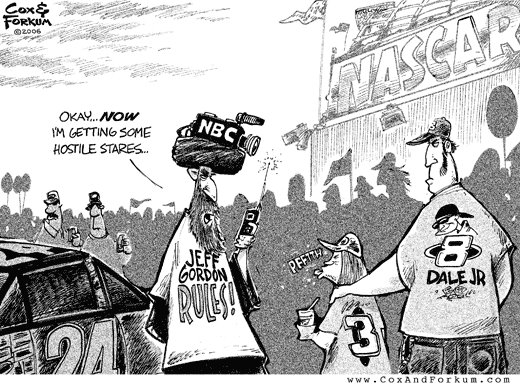
I don't always agree with her, but Michelle Malkin has been all over the NBC Dateline vs. NASCAR story.
For those of you who don't know what I am talking about, you can find out more about this story here, here, and here. You can read a copy of a letter sent to NBC by the chairman of the Henry County Board of Supervisors (where Martinsville Speedway is located) here.
Cartoon courtesy of Cox and Forkum.
Michael Totten heading back to Iraq
One of my favorite blogs is MichaelTotten.com. I have been reading Totten's work for over a year now and his coverage of the Middle East is fascinating. If you haven't checked out his work before, do so now.
Michael is headed back to Iraq - I can't wait for more.
Michael is headed back to Iraq - I can't wait for more.
Introduction
Hi there. I have been invited by Jarhed to contribute to his quasi-political, UK/U.S. commentary, diesel engine/car freak blog. Apparently he is oblivious to my lack of writing skills, he is far more eloquent than me. I tend to be really good at posting links of articles I find interesting with mono-syllabic commentary such as "read here" or "cool article" or "check this out" - I like to find interesting stuff to read by people whose commentary is more interesting than my own.
With that in mind, hope you like what I have to contribute. Jarhed tends to be far more conservative in the red blooded American, grease monkey, big block engine lovin' kind of way, and yes he lives in Scotland. I am a registered independent living in the Bay Area with a strong Libertarian streak who runs right down the middle of the political spectrum, or at least I think I do. Depending on who you speak to I am either a hardcore conservative who should pack up and move to Crawford, TX or I am a whining liberal who should just stop kidding himself and grow long hair and bang a drum on the UC Berkeley campus. So we hope our differing viewpoints make for some interesting commentary and spice things up a bit, although we strongly agree on many important points.
Well, enjoy this post, because it is probably the longest thing you will ever see me write. Although I could prove myself wrong in the future.......enjoy!
With that in mind, hope you like what I have to contribute. Jarhed tends to be far more conservative in the red blooded American, grease monkey, big block engine lovin' kind of way, and yes he lives in Scotland. I am a registered independent living in the Bay Area with a strong Libertarian streak who runs right down the middle of the political spectrum, or at least I think I do. Depending on who you speak to I am either a hardcore conservative who should pack up and move to Crawford, TX or I am a whining liberal who should just stop kidding himself and grow long hair and bang a drum on the UC Berkeley campus. So we hope our differing viewpoints make for some interesting commentary and spice things up a bit, although we strongly agree on many important points.
Well, enjoy this post, because it is probably the longest thing you will ever see me write. Although I could prove myself wrong in the future.......enjoy!
Monday, April 03, 2006
ARMs coming home to roost
an article on the bust that's beginning to happen as a result of the housing boom, on Yahoo news, the lucrative mortagages taken out by peple desperate fora home, only to find that as interest rates rise, so do the problems people are having. Most concerning is the $100 billion price tag being suggested by one analyst for such problems.
Sunday, April 02, 2006
ERF's Demise?
heard about ERF and that they are closing their doors very soon, right on the back of Foden's heels. However, for some reason, I can't seem to find a whole lot of news on the subject, so this will be short till I find out some more information. I will say that ERF was trailing Foden by about 25 units sold last year, and after seeing those numbers, I couldn't see that ERF was going to hold out much longer.
Paccar dumped Foden last year (the plant closes in summer of '06, well not close, shift production), after seeing flagging sales and also wondering what's the point of having a DAF with a Foden name badge and yank engine, and MAN is in the same boat with ERF. Once i find more, so will you, but in my head i was wondering what MAN was thinking for holding on to it for so long.
Paccar dumped Foden last year (the plant closes in summer of '06, well not close, shift production), after seeing flagging sales and also wondering what's the point of having a DAF with a Foden name badge and yank engine, and MAN is in the same boat with ERF. Once i find more, so will you, but in my head i was wondering what MAN was thinking for holding on to it for so long.
Sunday, January 29, 2006
Iraqi News
Good news from Iraq, and some very moving, I highly recommend the letter from the mayor of Tal Afar. I wonder why we never hear about these types of things from the AP and Reuters?
Monday, January 23, 2006
The last British truck, how long?
Saw an article recently regarding the demise of Foden, and how long ERF would last past that. FOund some figures that may shed some light. Before it gets further, the reason PAccar pulled the plug on Foden was new registrations were low, and there's really no point when the Foden shares everything with DAF sans engine. Likewise with ERF, the share MAN's platform, but only with cummins engines. Well, rumor has it Cummins couldn't make Euro 4, which throws the only engine into ERFs either the Cummins CE or BE engine, or MAN engines. Well, the CE and BE are common rail engines that are available in DAF, IVECO, MAN, and most likely more, and only for medium duty work. With the MAN engine the only choice available for heavy work, how long will it be before MAN decides that budgets are too tight to be messing around with name badge engineering, and axe the name that was .1% of total British sales behind Foden, which had 1.2%, or 705 new trucks sold. ERF had 669. If Paccar thought it prudent to axe Foden, would it be equally as prudent to axe ERF? my guess says yes, it does, it would make financial sense, but sad to see the last British Marque die, even if it only exists by name now. See BLB for stats and info.
Oil Scarcity, what's really true
In today's world there seems to be this looming feeling of impending doom as the belief that we will implode under the weight of our own demand for resources grows ever bigger. I've always held the opposite view, seeing oil prices artificially propped up, especially the UK, and more generally Europe and to a smaller extent, the US, by high taxes to try and keep oil usage down, by forcing people to "vote with their pocket books", so to speak, and buy smaller cars, smaller engines, and more costly energy saving features. Looking back to the older generation who always complained that gas was $.25 cents a gallon in my day, and hearing the news that fuel prices have hit record highs, what's the truth in that statement? Well, I've always been skeptical, and haven't really bought into the whole scarcity thing
As Humans, we have an inability to see infinity. We can't see that things will go on forever. I remember an conversation I had with my heavy chassis teacher in Tech school, and I was amazed at the amount of resources that went into making one class 8 truck. I also was reflecting on an article I had read about the same time about resource projections for metals, and how at current production and usage rates we had over 300 years of iron left. The mind boggles to think about the huge amount of metal that exists in the mountains, hills, and mines to furnish the entire world of millions of tons of metal a year for the next 300+ years. My instructor basically said, "why? The resources are there, and they aren't going anywhere, we won't be running out of anything." I doubted him, but if basic economics are true, and history has shown that it is, then he's right.
Which brings me to my current argument. Fuel prices are at an all time high, no one's disputing that. Every time I filled my Firebird with 20 gallons of premium 76 gas, the only fuel it ran cool enough on, I shelled out over 50 bucks. But I began to look deeper, if I can afford to shell out 50 buck at least twice a month, how much of my income was that? The answer startled me, and was backed up by this article, which basically states that oil prices have actually dropped, and it's the oil cartels and other factors that keep it propped up, and artificially so, since it became evident during OPEC I and II that the Saudis need our money more than we need their oil, and they're becoming more desperate to sell it, as increasing competition is making the percentage of oil that we import from them less and less, in short, we are becoming less dependent on them.
As we become more wealthy as a nation, be it UK or US, the percentage of our income that goes to buying essential things like fuel, food, shelter, etc. Actually becomes less, and therefore cheaper for us. Even if the price spikes, it may be a temporary fix to help right sagging energy prices. Looking at the cost of gasoline in the past 50 years, I noticed an interesting issue. If gas costs about $.25 cents a gallon in 1955, how much would it cost in 2005? Using a basic inflation calculator, I plugged in the numbers for that price of fuel currently, and then worked backwards. Using the basic price of $2.18 per gallon in the US in 2005, I came up with guess what? A whopping $.32 a gallon in 1955, a period of relative wealth in the US, being the boom times of post WWII. According to another website, gas cost $.23 a gallon in 1955, which amounts to $1.58 a gallon in 2005. According to the American Enterprise institute, income in 1929 adjusted to 1999 dollars for the average family was $15,745, which, using the trusty inflation calculator, amounts to $2,613 in 1955, and $17,952 in 2005, and in 1929 dollars, $1894. Funny that, considering that is well below today's and 1955's average of average family income. According to Heartbeats, a website devoted to 50's and 60's living, average income was a whopping $1500 more than in 1929, to $4,137. That amounts to $28,422 average family income. Still, well below the current average. According to the US Census, average household income in 2004 was $44,389. Which equates to $6635 in 1955 and $4,219 in 1929. So, as we can see here, our basic income has increased exponentially when compared to 1929 and 1955 values.
What's this got to do with oil? Well, seeing the fuel price in 1955 as $.23 cents a gallon, and the average household earned $4,137, that $.23 is a large percentage of that income. You could buy just under 17,986 gallons of fuel in a year with that price and income. Given today's income at $44,389, and today's record fuel price in 2005 of $2.18 a gallon, that same income could buy you just under 20,361 gallons of fuel, or a difference of 2,375 gallons of fuel difference. This indicates that a smaller portion of our income goes to buying fuel, and this doesn't take into consideration that the cars we buy today are far more fuel efficient than they were 50 years ago. Oil is becoming far cheaper, and the only reason fuel prices are as high as they are is because they are propped up by Oil cartels, and other false methods, such as heavy taxation.
According to the basic laws of supply and demand, prices go down when supply goes up. Even with the burden of heavy taxation and Oil Cartels, oil is becoming cheaper and more plentiful. One could argue that the propping up of the prices by the cartels and taxes are reducing demand and thereby creating more oil availability, but that isn't true. Despite the crushing taxes that are put in place by the various governments we so haphazardly elect, the oil cartels keep their prices up by limiting supply. Looking back simply 7 years ago, we find that oil prices were low, and the cartels were struggling to keep oil prices above $20 a barrel, we were paying approximately $ a gallon for gas. Adjust that to 1955 prices and we see that it is 2 1955 cents lower.
With the rise in the ability for us to extract oil form the ground, more finds in exploration, tar sands, shale oil, etc. We have more oil from more sources than we know what to do with, and being from more locations, less dependent on foreign sources. With a more stable Iraq, which is only 2nd to Saudi Arabia in oil wealth, which, I might add, is estimated with old data, extraction methods, exploration methods, and a former political instability problem, oil will only become cheaper and more abundant. What a wonderful world we live in. Seriously, let's stop living like we need to control everything that has to do with energy, and let the markets do their job. Read the entire article from PNAS, it's worth it.
As Humans, we have an inability to see infinity. We can't see that things will go on forever. I remember an conversation I had with my heavy chassis teacher in Tech school, and I was amazed at the amount of resources that went into making one class 8 truck. I also was reflecting on an article I had read about the same time about resource projections for metals, and how at current production and usage rates we had over 300 years of iron left. The mind boggles to think about the huge amount of metal that exists in the mountains, hills, and mines to furnish the entire world of millions of tons of metal a year for the next 300+ years. My instructor basically said, "why? The resources are there, and they aren't going anywhere, we won't be running out of anything." I doubted him, but if basic economics are true, and history has shown that it is, then he's right.
Which brings me to my current argument. Fuel prices are at an all time high, no one's disputing that. Every time I filled my Firebird with 20 gallons of premium 76 gas, the only fuel it ran cool enough on, I shelled out over 50 bucks. But I began to look deeper, if I can afford to shell out 50 buck at least twice a month, how much of my income was that? The answer startled me, and was backed up by this article, which basically states that oil prices have actually dropped, and it's the oil cartels and other factors that keep it propped up, and artificially so, since it became evident during OPEC I and II that the Saudis need our money more than we need their oil, and they're becoming more desperate to sell it, as increasing competition is making the percentage of oil that we import from them less and less, in short, we are becoming less dependent on them.
As we become more wealthy as a nation, be it UK or US, the percentage of our income that goes to buying essential things like fuel, food, shelter, etc. Actually becomes less, and therefore cheaper for us. Even if the price spikes, it may be a temporary fix to help right sagging energy prices. Looking at the cost of gasoline in the past 50 years, I noticed an interesting issue. If gas costs about $.25 cents a gallon in 1955, how much would it cost in 2005? Using a basic inflation calculator, I plugged in the numbers for that price of fuel currently, and then worked backwards. Using the basic price of $2.18 per gallon in the US in 2005, I came up with guess what? A whopping $.32 a gallon in 1955, a period of relative wealth in the US, being the boom times of post WWII. According to another website, gas cost $.23 a gallon in 1955, which amounts to $1.58 a gallon in 2005. According to the American Enterprise institute, income in 1929 adjusted to 1999 dollars for the average family was $15,745, which, using the trusty inflation calculator, amounts to $2,613 in 1955, and $17,952 in 2005, and in 1929 dollars, $1894. Funny that, considering that is well below today's and 1955's average of average family income. According to Heartbeats, a website devoted to 50's and 60's living, average income was a whopping $1500 more than in 1929, to $4,137. That amounts to $28,422 average family income. Still, well below the current average. According to the US Census, average household income in 2004 was $44,389. Which equates to $6635 in 1955 and $4,219 in 1929. So, as we can see here, our basic income has increased exponentially when compared to 1929 and 1955 values.
What's this got to do with oil? Well, seeing the fuel price in 1955 as $.23 cents a gallon, and the average household earned $4,137, that $.23 is a large percentage of that income. You could buy just under 17,986 gallons of fuel in a year with that price and income. Given today's income at $44,389, and today's record fuel price in 2005 of $2.18 a gallon, that same income could buy you just under 20,361 gallons of fuel, or a difference of 2,375 gallons of fuel difference. This indicates that a smaller portion of our income goes to buying fuel, and this doesn't take into consideration that the cars we buy today are far more fuel efficient than they were 50 years ago. Oil is becoming far cheaper, and the only reason fuel prices are as high as they are is because they are propped up by Oil cartels, and other false methods, such as heavy taxation.
According to the basic laws of supply and demand, prices go down when supply goes up. Even with the burden of heavy taxation and Oil Cartels, oil is becoming cheaper and more plentiful. One could argue that the propping up of the prices by the cartels and taxes are reducing demand and thereby creating more oil availability, but that isn't true. Despite the crushing taxes that are put in place by the various governments we so haphazardly elect, the oil cartels keep their prices up by limiting supply. Looking back simply 7 years ago, we find that oil prices were low, and the cartels were struggling to keep oil prices above $20 a barrel, we were paying approximately $ a gallon for gas. Adjust that to 1955 prices and we see that it is 2 1955 cents lower.
With the rise in the ability for us to extract oil form the ground, more finds in exploration, tar sands, shale oil, etc. We have more oil from more sources than we know what to do with, and being from more locations, less dependent on foreign sources. With a more stable Iraq, which is only 2nd to Saudi Arabia in oil wealth, which, I might add, is estimated with old data, extraction methods, exploration methods, and a former political instability problem, oil will only become cheaper and more abundant. What a wonderful world we live in. Seriously, let's stop living like we need to control everything that has to do with energy, and let the markets do their job. Read the entire article from PNAS, it's worth it.
Monday, January 09, 2006
Mondeo Enthusiasts
Check out www.fordmondeo.org, a site I belong to, and yeah, I know, everyone that hears about this says the same thing (including my wife), there are people who actually like mondeos? Well, actually, yes, they do, and the people you meet there are some of the best I've found in a forum. Enjoy.
Glenn Vs. James
Via Lileks, a great post on the blind rage that seems to be pervasive with today's younger generation and the anti-Christian/western/liberty crusade that seems to be the hot topic on today's media hot list. What's interesting, is Glenn Reynolds seems to think that this type of thinking "betrays a certain lack of perspective." I'm not seeing the lack of perspective that Glenn seems to think, and while I agree with Glenn on many points, there seems to be a severe resistance to anything that has to do with someone telling someone else what to do, as Libertarians seems to have a fear of organized religion, government, etc. For instance, his post on what he suggested about marriage and how it ought to be separated from the state seems to be made somewhat haphazardly. I can understand his point, why should it be up to the government to decide who should marry whom? But the problem is, when it comes to marriage, it affects more than just 2 people, (or in Glenn's case when Polygamy and the like is suggested, as many as you like), it affects the children that come from the union, and their children, and so on. As the family is the core unit of society, and the basic governing unit that has to do with keeping society under control, when you remove the structure that underpins that, society will fall flat on its face. It isn't like putting fuel mileage law's on new cars that are built, cars do not behave on their own accord (well, mostly), but people do, and if we remove how newbies into the world are taught, then disaster looms in the distance. Don't get me wrong, I'm all for keeping the state out of my home, out of my car, and out of my place of business and wallet, but no laws are just as bad as too many, and you end up in a worse place than when you started. Sorry Glenn, can't agree on this one.
Sunday, January 08, 2006
Time to wake up
Great article on what needs to happen to Europe, soon, before it's swallowed up in the tide of events that are overtaking it. I fear that Euorpe is faltering, and if it snowballs, they may not have the ability to change it, the brink isn't very far away.
Subscribe to:
Posts (Atom)
