Sam woke up from his nap and he left to ask the conductor when we would finally reach Jaipur station. He came back about 10 minutes later. “No idea” seemed to be the reply from the conductor. Great.
We finally started to slow down and I could see the shadows of buildings through the train window. Finally, we began to really slow down and Sam and I started pulling our luggage out from under the seat and getting ready to disembark. It was after 1am, more than 1 hour behind schedule and I was hot, dirty, sticky, and tired, not to mention a very uncomfortable stomach from holding my bowels for so long.
We got off the train in Jaipur and the station was packed with people either coming to pick up passengers or sitting glassy-eyed, having waited more than 1 hour for the train to arrive so they could get on, headed for Delhi which was the final stop. Once again, groups of young men accosted us, hoping to carry our bags for us. We ignored them and walked swiftly to the main exit where our driver was supposedly waiting.
We stepped out of the station and our driver met us. We had to carefully step over the sleeping bodies in the dark outside of the train station. As in Jodhpur there was a sizeable homeless population that actually lived at the train station. We got our luggage into the car, which was at least 40 years old, and finally started heading toward the hotel. Long story short, by the time I got checked into the hotel it was 2am and we had to check out and leave within 7 hrs!!! Not a recipe for a good night’s sleep. I couldn’t wait to get into my hotel room and use the bathroom. I took a cool shower that lasted a good 30 minutes to wash off hours of sweat and dust that had accumulated on my body over the long day. It felt wonderful.
All too soon the alarm went off and I was up and getting dressed. I was dead tired but nothing could be done about it as I had a lot of work to do. I didn’t eat much for breakfast and wearily met Sam in the lobby. He looked about as tired as I was.
We headed out for the first factory. Jaipur is a much bigger city than Jodhpur, I believe Sam told me around 2 million or so, I could be wrong, but it certainly seemed more metropolitan than Jodhpur, although traffic, like anywhere in India, was still completely insane, complete with wandering cows, the occasional camel, and pedestrians/bikers darting in and out of traffic in both directions. On all the major streets there were signs in the center divider proclaiming “Jaipur, the pink city, welcome to green” or something to that effect. They should have called it “Jaipur, the litter city, welcome to the brown” because that is mostly what I saw. While Jaipur is closer to Delhi and further inland than Jodhpur, it is still in Rajasthan and still on the border of the Thar desert. So the climate is rather dry, hence not a lot of greenery in the city. There were trees lining the roadways but everywhere else was dry and brown. And there was litter everywhere, every roadway, every alley, every street was strewn with litter. At least the commercial and industrial districts were slightly better.
I won’t bore you with the details of my factory visits, only to say that the factories in Jaipur were more established and organized than the ones in Jodhpur. Jaipur’s industrial area was a bit more in line with what one would expect in another country, although still not on a scale as one would see in a highly developed country. We met a lot of very nice people and got a lot of work done and then we went to lunch. We drove forever until I saw a shiny, gleaming building off in the distance. As we got closer I could see line upon line of motorcycles and cars parked around it. Eventually I could see that it was a shopping mall, a rather new one, complete with movie theater and a full line of restaurants. What was odd about it, though, was that there was nothing around it. I mean nothing. There were several main roads around the immediate area and some minor construction going on, but the land surrounding the mall was mostly bare dirt. Across one of the streets were a number of tents and tin shacks where people lived. It seemed incredibly odd and yet growingly familiar to see poverty slammed up against wealth, living side by side and across from each other. As we pulled up to one of the parking areas I could see people in the “tent city” as I liked to call it tending cows or chickens or washing clothes in the clearly polluted waterway that tumbled alongside the main road. And yet, just feet away, was this gleaming air conditioned mall which was clearly for the local wealthy and upper middle class, as could be judged by the model of car and shiny motorcycles in the parking lots. Just steps away from each other and yet both sides seemed perfectly content with each other as people from both sides seemed completely ignorant of the other.
We walked in and the first thing I saw was a McDonalds. I chuckled and commented that no matter where I went in the world, no matter how distant the country or remote the location, I always seemed to be stumbling into a McDonalds (or a Starbucks). Sam stopped dead in his tracks.
“You don’t LIKE McDonalds ?!?!?!”, he said.
“Um, no, not particularly, but if you want to go there that’s fine”, I replied.
“But all Americans LOVE McDonalds! I thought you would WANT to go there!”
I quickly realized that despite the plethora of interesting restaurants in the mall that Sam had fully intended to bring me to McDonalds: a restaurant I had not eaten in since I can’t remember (I am not much of a fast food fan and have never really liked McDonalds anyways) and where you can’t walk 10 feet in America without tripping on one, where I could go whenever I wanted. And yet here I am in Jaipur, India and my guide wants to take me there to eat.
I kindly explained to Sam that if he wanted to go there we could, but that I could eat McDonalds anytime of the week back home, so why don’t we try something else? He smiled agreeably and quickly chose a nice Indian restaurant nearby, seeming both relieved and surprised to find that I did not particularly favor McDonalds. Apparently he must have had different, welcoming reactions in the past from foreign visitors he had hosted in India.
In the afternoon we visited 2 more non-furniture factories and then it was off to the Jaipur airport to head back to Delhi. Jaipur airport was larger than Jodhpur, but not by much. There was one rather small check in area for the 3-4 domestic airlines that serviced Jaipur and a single gate for all flights. It only required 1 small board to display the handful of flights leaving over the next 4 hrs. Keep in mind this is for a city of more than 2 million people.
As we checked in the gate the girl behind the counter wanted to charge us like $50 for heavy luggage. Huh? We both had carry ons, that’s it. Turns out we were taking a propeller plane back to Delhi and so bags had to be extremely light – mine was 1 kg over the limit. But with some quick explaining and pleading in Hindi by Sam they let it go.
We then sat in the gate area waiting for the flight to arrive so we could leave. We had 20 minutes before the flight was scheduled to leave. 10 minutes later they announced the flight would be delayed by 5-10 minutes. By this time I was used to it. I knew that 5-10 minutes could mean up to 1 hour. Sure enough, nearly 1 hr later the plane arrived. We had to walk from the gate out onto the tarmac – no buses – and climb into the plane. It was a long walk. I forget what kind of plane it was, but it was definitely the smallest plane I had ever ridden in. Very tiny, narrow seats and I think the plane held only 30-40 people. Once again we sat on the tarmac waiting…..for what?!? There wasn’t a plane in sight.
Finally we took off and I was asleep before we reached cruising altitude. Sam nudged me awake not 45 minutes later “We are landing”, he said. We circled for what seemed like forever. Finally we landed, only 1 ½ hrs later than scheduled. Inside the airport it was complete chaos. We could barely move through the crowds to get our luggage. There were multiple flights being handled by the tiny handful of luggage carousels and mass confusion by passengers ensued as it was difficult to figure out which carousel was handling which flight. Bags and suitcases were piled everywhere as airport workers simply removed them and stacked them on the floor to make more room on the carousels. The heat and humidity and odor from hundreds, if not thousands, of crushing bodies was overwhelming. Outside was just as bad, traffic was like a parking lot, a cacophony of horns and angry drivers yelling at each other. Swarms of people milled about uncertainly, looking for their rides or buses. We found our driver who looked supremely relieved.
“I have been waiting for nearly 2 hrs. I asked the airport people when your flight was coming in. They told me they had no record of the flight. I argued with them and then they said they had no idea when the flight would land. I checked later and the new person told me that your airline didn’t exist, which is impossible as it is a major domestic airline. I must have talked to 10 different people, none of whom seemed to have the first clue what I was talking about.”
This was a major domestic airline with 2 daily flights to and from Delhi and Jaipur as well as at least a dozen other cities. And nobody in the airport seemed to have a clue.
I stayed in the same hotel as the first night, except this time they had a nicer room for me, much larger and plush than the first night and for the same price too!
I settled down for a nice long sleep, but my stomach interrupted me around 4am or so. Little did I know that my troubles were just beginning……
To be continued.
Monday, June 12, 2006


Saturday, June 10, 2006
GM has claws?
Found this originally by instapundit, but read on GM's own blog, which is fascinating. Seems the NYT printed a particularly nasty article regarding GM and such and really watered down GM's reply, to the point of GM basically saying, it's so far from what we want, just forget it. I'd love to link the NYT article, but subscription required, so that's the best you'll get (sans subscription, of course). You can find GM's rebuttal here, their frustration at the lack of commitment to printing GM's rebuttal here, GM's original rebuttal here, their edited version, here, and the emails back and forth from the NYT and GM, here.
What I find interesting is his point that the sooner GM gets acquired by Toyota, the better. Now I'm fully aware that GM has been working very hard at going out of business, and they can't even do that properly, but I do believe that the demise of GM and/or Ford would be very bad at best and disastrous at worst for our economy. The fact that GM has so many employees, and has such a vast and massive structure is a good reason to be wary of a giant such as GM failing totally.
GM has had some very rough times, and rightly so, they have made some disastrous decisions, but to hope for the acquisition of a domestic company by a foreign one is not really something I'd hope for. GM has had quality issues for years, but one thing they have always been very cutting edge on is technology. I look at my 1974 Firebird for examples of that, including inertia lock seatbelts (man I love those things), ice cold air conditioning (not working at the moment, due to previous owner's compressor removal), tough, robust transmissions, strong engines, tilt steering, and many other things taken for granted today.
They were one of the first to come out with 5 and 6 speed transmissions, though they never installed them in their own vehicles, but sold them to the likes of Mercedes and BMW for their vehicles. They were also messing with 4 speed overdrives before WWII. GM does have immense ability, but like the Goliath of the Old Testament, has arrogance and moves slowly. I see this changing, and hopefully it will pull them out of the brink of takeover. Let's hope, not necessarily for GM's sake, but for the US economy's.
What I find interesting is his point that the sooner GM gets acquired by Toyota, the better. Now I'm fully aware that GM has been working very hard at going out of business, and they can't even do that properly, but I do believe that the demise of GM and/or Ford would be very bad at best and disastrous at worst for our economy. The fact that GM has so many employees, and has such a vast and massive structure is a good reason to be wary of a giant such as GM failing totally.
GM has had some very rough times, and rightly so, they have made some disastrous decisions, but to hope for the acquisition of a domestic company by a foreign one is not really something I'd hope for. GM has had quality issues for years, but one thing they have always been very cutting edge on is technology. I look at my 1974 Firebird for examples of that, including inertia lock seatbelts (man I love those things), ice cold air conditioning (not working at the moment, due to previous owner's compressor removal), tough, robust transmissions, strong engines, tilt steering, and many other things taken for granted today.
They were one of the first to come out with 5 and 6 speed transmissions, though they never installed them in their own vehicles, but sold them to the likes of Mercedes and BMW for their vehicles. They were also messing with 4 speed overdrives before WWII. GM does have immense ability, but like the Goliath of the Old Testament, has arrogance and moves slowly. I see this changing, and hopefully it will pull them out of the brink of takeover. Let's hope, not necessarily for GM's sake, but for the US economy's.
Friday, June 09, 2006
Security India style and an interesting train ride.
The next morning I had a fantastic breakfast at the hotel. I wish I could tell you what I ate, but I have no idea what any of it was called. Mostly small, pancake-like flatbread thingies with bits of spices and vegetables cooked into them. Lots of fruits and a thick, warm drink that was some kind of yoghurt – not lassi, I know what a lassi is, this was different.
Two of the workers in the hotel restaurant were distinctly Chinese. I was surprised, not that there aren’t a lot of Chinese in India, but this was Jodhpur, not Delhi or Bombay, and I had not seen anyone so far who wasn’t Indian except for the small handful of Caucasian tourists and businessmen in my hotel. I motioned one of them over and asked her in Mandarin if she was from China. The minute she heard me speaking Chinese she quickly motioned her co-worker over and began excitedly to speak to me in bullet-fast Mandarin which, unfortunately, was a bit too fast for me. She said she had never met a foreigner (meaning a white westerner) who spoke Chinese before. She had been in Jodhpur since she was a young girl, apparently her father knew someone who referred him to work in Jodhpur, doing what I don’t know, so her family moved to Jodhpur many years ago. Somehow they convinced her friend’s family to move there as well and then she and her friend began working in the hotel industry in Jodhpur. She said she liked India, but it was too hot and she often missed China. I took it from the conversation that they didn’t get to go back too often. She said there more Chinese in Jodhpur than I thought, although they were small in number compared to the larger cities in India.
Sam came and picked me up and off we went to visit more furniture factories. The first factory we visited was very similar to the ones from the day before, but the second one seemed newer and was definitely more modern in its construction and style. Still no AC, but they had a very pleasant reception area with soft couches, satellite TV, and a fridge full of cold drinks. I was also surprised to find that they had a very high tech biometric fingerprint ID system for all their employees. Each employee’s fingerprint had been scanned into the system along with a unique ID number. When they entered, they had to scan their fingerprint where the computer would almost immediately verify their print and corresponding ID number. If it didn’t match, access was denied. Most companies I have visited, and even worked for, usually settled for the old ID badge on a lanyard or clip approach.
The person who was guiding us around the factory was the CEO. And he was very young, perhaps mid to late 20’s. My mom once came to visit me in Hong Kong many years ago and was amazed to find that “…all the young people are in charge….”, in her words. It has been a common observation of mine throughout my travels to Asia that it is not uncommon to find rather young people in relatively high positions within companies. The same was true of India. Most of the factories I visited I was meeting partners, CEOs, COOs, Directors, etc. In most cases, they were very young, usually mid 20’s – early 30’s. This factory was yet another case.
All the factories had hired private 24 hr security and had guard posts at the main entrance to each factory. These guards were always in uniform, usually long sleeved with high boots and hats. They worked in shifts, but it must have been horribly uncomfortable in the hot desert sun to stand there all day. At this factory, most of the security were ex-police. I asked the gentleman showing us around if he had procedures for reporting and investigating security incidents, a common question I ask. He said he would show me their documented procedures back in the office. I said that was fine, but wanted to know what would happen if an unauthorized person was found on the premises doing something illegal.
“Simple.”, He said. “First we would notify security on duty. Next we would apprehend him. Of course, we will call the cops and they will come. But first, we will beat him.”, he said with a wicked smile. “Nobody is foolish enough to try and steal anything from us. The police are poorly paid and stationed far away, so you might have to wait a long time for them to arrive.” He smiled again. I understood his meaning. Anyone caught stealing could be in for a long wait before the cops arrived and a lot could happen between the time they were called and the time they showed up.
We had lunch at the factory office and again I can’t say enough about Rajasthan Indian food. It is outstanding.
We hit one final factory in the afternoon which was also a furniture factory. I was amazed at all these furniture factories, which were making 100% wood furniture and was curious to know how much wood they were going through per day. I asked the manager who was guiding us around what the wood supply was like. He said it was getting tough to find good wood as the forests were getting decimated. But he said it in a way that sounded unconcerned. I asked him what he would do when there was no more wood. He shrugged his shoulders nonchalantly and simply stated “then we will just use something else to make furniture, maybe metal or plastic or fabric”. He did not seem too concerned.
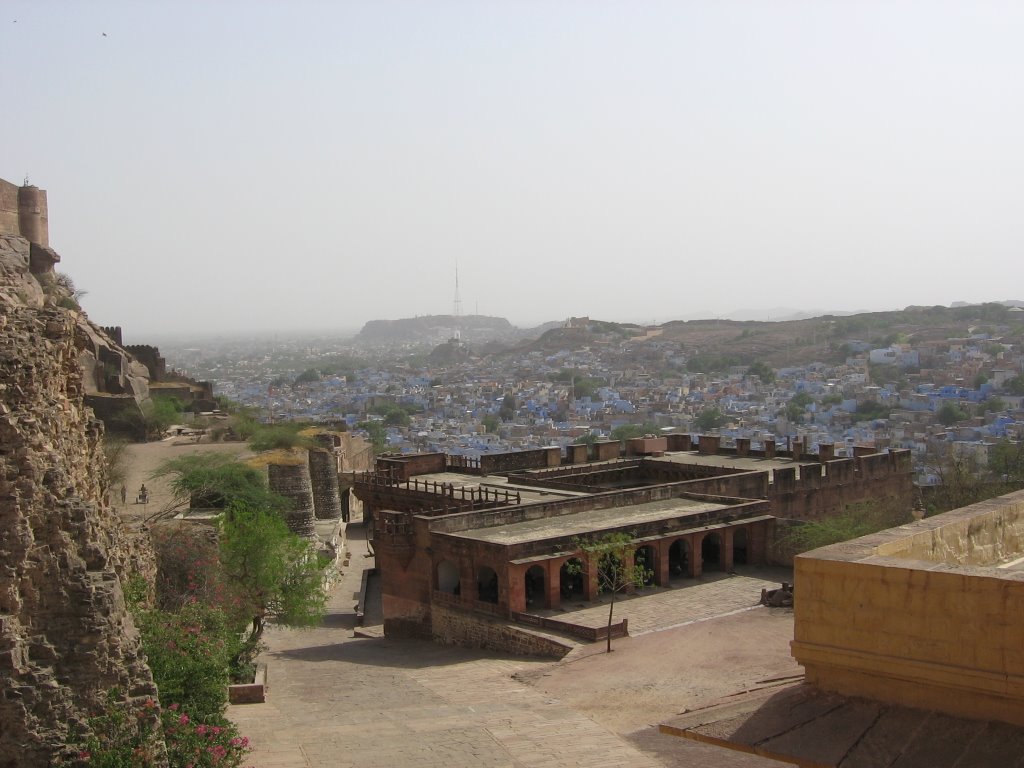
We decided we had enough time to catch one of the local tourist attractions, which is a giant old fort built onto a high plateau more than 500 years ago. So here I was, walking up steep hills and tall staircases to get to the top of this fort in long slacks and black shoes with a button down short sleeved shirt. We were in the sun most of the time and it was about 110 degrees. Sam bought two 1 liter bottles of water. It wasn’t enough and we had to get more. Basically, in the short 2 hrs that we toured the fort, I downed 2 liters of water – and never went to the bathroom even once. Our clothes were drenched in sweat and my digital camera was so hot in the burning sun that I had to keep switching hands because the metal was so hot. Every time I brought the camera to my eye it felt like the eyepiece was burning my skin. The fort was fantastic and I took a lot of pictures. In 500 years its walls had never been breached, the fort never taken. It was a fascinating place and hard to believe that they managed to build such a place on a high plateau with no modern equipment.
Finally it was time for us to leave. We got in our car and cranked the AC to full blast, which basically meant that the temperature inside the car dropped to about 90, but when you have been walking around in 110 degree weather, 90 feels pretty good. You are still sweating, but feel much more comfortable.
We had to take the train from Jodhpur to our next destination which was Jaipur, another city in Rajasthan, but much larger (about 2-3 million people) and a little closer to Delhi. We were originally supposed to fly, but the airline cancelled the flight at the last minute. So we were stuck with the train.
I had some expectation as to what traveling by train might be like having spent some time in China. The Guangzhou rail station is an experience in itself. So it wasn’t complete culture shock when I got to the station, but still somewhat unsettling. If I thought the domestic terminal at Delhi airport was bad, this was 10 times worse. The words “utter chaos” describe the scene outside the train station, although it also could have been due to the fact that the train was scheduled to leave in a matter of minutes and the next one wasn’t until the morning, so maybe it was last minute rush (which we were).
As we got out of the car Sam grabbed my cell phone. He told me quickly and quietly to bury it in my luggage. I wasn’t wearing a watch but Sam took his off and jammed it in his front pocket. He said the crime at the train station was pandemic and that thieves were very skillful and clever in relieving even the wary of their personal belongings. I decided to listen to him.
The train station was packed with homeless. People in some of our cities here in America are concerned about our own homeless problems. Compared to this, we don’t have a homeless problem. It was heartbreaking. These weren’t just homeless begging for some change before they moved on to something else. Most of the people actually lived there. There were dirty hunks of cardboard and newspaper that served as sleeping mats and what really hurt was seeing the women and children. There was nothing you could do. You wanted to help them all, but I could have emptied every dollar in my pocket and still not had enough to give something to everyone, even if I was only handing out dimes or nickels, not to mention the total riots it would cause if I did do something like that. It was a sad, overwhelming, helpless feeling.
Sam could see what was going through my mind and must have explained this before to virgin western eyes.
“You can only do so much. And don’t feel too sorry for these people. Some of them are here because they can make more money begging at the train stations than they can working the fields or farms in the villages they come from. So they leave their families and farms and prefer to live at the train station. Some of them are truly bad, they will dirty themselves and their children, hoping that the more pitiful they look the more money they will get. But yes, many of them are truly destitute and poor and this is their final option. We have too many people, not enough jobs, and the government does nothing.”
I didn’t have anything to add after that, I just felt helpless and remained quiet.
Once we entered the train station, hordes of young men literally attacked our bags.
“Carry your bag for you sir?”
“Where you going sir?”
“Let me help you sir.”
“You need someone to help you to the train?”
Sam physically pushed them off while I firmly shook my head and pulled on my luggage. Sam told me they will grab your bags before you know it and just walk off. He said most of them just want to earn an honest buck and will take your luggage to your car and load it in, expecting of course a big fat tip. But some of them are outright thieves and will disappear with your luggage faster than you can blink.
We finally made our way to the first class cabin, which is the only cabin with AC. Mercifully, the AC was halfway decent, keeping things right around 80 degrees inside the car. Unfortunately, the train looked like something out of a Soviet nightmare 40-50 years ago. Surely it wasn’t that old, but it sure looked it. Everything looked beat up, the colors were faded, and everything looked old and worn out, even if it wasn’t. And remember, this was the first class cabin.
We very carefully stowed our luggage as deep as possible underneath the seats far away from any wayward hands. Sam said sometimes thieves and even railway workers would sneak into first class cabins to steal things from people’s luggage. Hey thanks, that makes me feel much better.
As usual, nothing was on time. We sat and sat and sat. Finally Sam went and bought us a couple of magazines to read while we waited – it was a 5 hr train ride to Jaipur which meant we would be pulling in somewhere around 12am midnight.
We were the only 2 guests in the car until a third gentleman came in. So far all the Indians I met were big on greetings and chit chat and this gentleman was no exception. Business cards were exchanged, hands were shook, and soon we were all engrossed in conversation. This gentleman worked for the government, the forestry service to be exact and was working on arid research projects in Rajasthan. I asked him how he liked his job.
“It is a very interesting and challenging service. Everyday we are trying to manage the forests and environment in India, trying to find new ways of conservation and also learning how to grow in the deserts of Rajasthan. It is tough work, but I enjoy it.”
I mentioned to him about my conversation with one of the factories we visited, where the factory did not seem concerned about running out of wood.
He let out a long sigh. “Our job is very difficult. There are not enough of us and our budget is too small. It is difficult to preach conservation when the entire country is trying to develop itself.”
But what about renewable forestry practices? Tree farms? Planting projects?
“Yes, yes, we have all these things, but you must understand that it is all too little. Also, many of the people in the country are very rural, they still live the old fashioned way. They are not even aware of the laws, nor would they follow them if they knew. How can we tell them ‘you can not cut down these trees for your home or farm or fire because we need to conserve our forests’ when it is the only thing that allows them to survive? And there are many corrupt lumber companies who will illegally harvest lumber, rarely with any punishment. Of course, the biggest problem we have is apathy, some people just don’t care. Still, I am optimistic, as more people become aware of the damage we are doing to our forests they will take action and steps are progressively being taken to preserve our environment. I enjoy the work I do.”
Soon we were all feeling tired and conversation slowly ended as one by one we began to fall asleep. I needed to use the restroom, so I got up and weaved my way back and forth down the hall to the restroom.
Do you remember the scene in The Mummy Returns when the hero’s son is on the train in Egypt and needs to use the restroom? Do you remember the restroom? Picture it in your mind.
THAT, was my restroom. I entered a filthy room with a broken, dim light. No toilet paper, not even the obligatory can of water by the toilet. I lifted the lid up and the seat was a motley mess of dark colors, scratches, and deep grooves, with dark stains of who knows what that had been stained permanently into the toilet for who knows how long. I had to go, well, you know, the big one, but I was damned if I was going to even attempt it, especially with no toilet paper. So I sucked up and puckered up and held it all in, praying for a quick arrival into Jaipur. Sure enough, when you “flushed” the toilet a hole simply appeared where your business disappeared onto the tracks below which were flying by. Luckily the sink had its own water supply and anti-bacterial soap, but that was the only comfort.
I settled back into my seat rather uncomfortably as I was now holding in a day’s worth of spicy Indian food and just sweated it out waiting to arrive in Jaipur.
To be continued…….
Two of the workers in the hotel restaurant were distinctly Chinese. I was surprised, not that there aren’t a lot of Chinese in India, but this was Jodhpur, not Delhi or Bombay, and I had not seen anyone so far who wasn’t Indian except for the small handful of Caucasian tourists and businessmen in my hotel. I motioned one of them over and asked her in Mandarin if she was from China. The minute she heard me speaking Chinese she quickly motioned her co-worker over and began excitedly to speak to me in bullet-fast Mandarin which, unfortunately, was a bit too fast for me. She said she had never met a foreigner (meaning a white westerner) who spoke Chinese before. She had been in Jodhpur since she was a young girl, apparently her father knew someone who referred him to work in Jodhpur, doing what I don’t know, so her family moved to Jodhpur many years ago. Somehow they convinced her friend’s family to move there as well and then she and her friend began working in the hotel industry in Jodhpur. She said she liked India, but it was too hot and she often missed China. I took it from the conversation that they didn’t get to go back too often. She said there more Chinese in Jodhpur than I thought, although they were small in number compared to the larger cities in India.
Sam came and picked me up and off we went to visit more furniture factories. The first factory we visited was very similar to the ones from the day before, but the second one seemed newer and was definitely more modern in its construction and style. Still no AC, but they had a very pleasant reception area with soft couches, satellite TV, and a fridge full of cold drinks. I was also surprised to find that they had a very high tech biometric fingerprint ID system for all their employees. Each employee’s fingerprint had been scanned into the system along with a unique ID number. When they entered, they had to scan their fingerprint where the computer would almost immediately verify their print and corresponding ID number. If it didn’t match, access was denied. Most companies I have visited, and even worked for, usually settled for the old ID badge on a lanyard or clip approach.
The person who was guiding us around the factory was the CEO. And he was very young, perhaps mid to late 20’s. My mom once came to visit me in Hong Kong many years ago and was amazed to find that “…all the young people are in charge….”, in her words. It has been a common observation of mine throughout my travels to Asia that it is not uncommon to find rather young people in relatively high positions within companies. The same was true of India. Most of the factories I visited I was meeting partners, CEOs, COOs, Directors, etc. In most cases, they were very young, usually mid 20’s – early 30’s. This factory was yet another case.
All the factories had hired private 24 hr security and had guard posts at the main entrance to each factory. These guards were always in uniform, usually long sleeved with high boots and hats. They worked in shifts, but it must have been horribly uncomfortable in the hot desert sun to stand there all day. At this factory, most of the security were ex-police. I asked the gentleman showing us around if he had procedures for reporting and investigating security incidents, a common question I ask. He said he would show me their documented procedures back in the office. I said that was fine, but wanted to know what would happen if an unauthorized person was found on the premises doing something illegal.
“Simple.”, He said. “First we would notify security on duty. Next we would apprehend him. Of course, we will call the cops and they will come. But first, we will beat him.”, he said with a wicked smile. “Nobody is foolish enough to try and steal anything from us. The police are poorly paid and stationed far away, so you might have to wait a long time for them to arrive.” He smiled again. I understood his meaning. Anyone caught stealing could be in for a long wait before the cops arrived and a lot could happen between the time they were called and the time they showed up.
We had lunch at the factory office and again I can’t say enough about Rajasthan Indian food. It is outstanding.
We hit one final factory in the afternoon which was also a furniture factory. I was amazed at all these furniture factories, which were making 100% wood furniture and was curious to know how much wood they were going through per day. I asked the manager who was guiding us around what the wood supply was like. He said it was getting tough to find good wood as the forests were getting decimated. But he said it in a way that sounded unconcerned. I asked him what he would do when there was no more wood. He shrugged his shoulders nonchalantly and simply stated “then we will just use something else to make furniture, maybe metal or plastic or fabric”. He did not seem too concerned.
We decided we had enough time to catch one of the local tourist attractions, which is a giant old fort built onto a high plateau more than 500 years ago. So here I was, walking up steep hills and tall staircases to get to the top of this fort in long slacks and black shoes with a button down short sleeved shirt. We were in the sun most of the time and it was about 110 degrees. Sam bought two 1 liter bottles of water. It wasn’t enough and we had to get more. Basically, in the short 2 hrs that we toured the fort, I downed 2 liters of water – and never went to the bathroom even once. Our clothes were drenched in sweat and my digital camera was so hot in the burning sun that I had to keep switching hands because the metal was so hot. Every time I brought the camera to my eye it felt like the eyepiece was burning my skin. The fort was fantastic and I took a lot of pictures. In 500 years its walls had never been breached, the fort never taken. It was a fascinating place and hard to believe that they managed to build such a place on a high plateau with no modern equipment.
Finally it was time for us to leave. We got in our car and cranked the AC to full blast, which basically meant that the temperature inside the car dropped to about 90, but when you have been walking around in 110 degree weather, 90 feels pretty good. You are still sweating, but feel much more comfortable.
We had to take the train from Jodhpur to our next destination which was Jaipur, another city in Rajasthan, but much larger (about 2-3 million people) and a little closer to Delhi. We were originally supposed to fly, but the airline cancelled the flight at the last minute. So we were stuck with the train.
I had some expectation as to what traveling by train might be like having spent some time in China. The Guangzhou rail station is an experience in itself. So it wasn’t complete culture shock when I got to the station, but still somewhat unsettling. If I thought the domestic terminal at Delhi airport was bad, this was 10 times worse. The words “utter chaos” describe the scene outside the train station, although it also could have been due to the fact that the train was scheduled to leave in a matter of minutes and the next one wasn’t until the morning, so maybe it was last minute rush (which we were).
As we got out of the car Sam grabbed my cell phone. He told me quickly and quietly to bury it in my luggage. I wasn’t wearing a watch but Sam took his off and jammed it in his front pocket. He said the crime at the train station was pandemic and that thieves were very skillful and clever in relieving even the wary of their personal belongings. I decided to listen to him.
The train station was packed with homeless. People in some of our cities here in America are concerned about our own homeless problems. Compared to this, we don’t have a homeless problem. It was heartbreaking. These weren’t just homeless begging for some change before they moved on to something else. Most of the people actually lived there. There were dirty hunks of cardboard and newspaper that served as sleeping mats and what really hurt was seeing the women and children. There was nothing you could do. You wanted to help them all, but I could have emptied every dollar in my pocket and still not had enough to give something to everyone, even if I was only handing out dimes or nickels, not to mention the total riots it would cause if I did do something like that. It was a sad, overwhelming, helpless feeling.
Sam could see what was going through my mind and must have explained this before to virgin western eyes.
“You can only do so much. And don’t feel too sorry for these people. Some of them are here because they can make more money begging at the train stations than they can working the fields or farms in the villages they come from. So they leave their families and farms and prefer to live at the train station. Some of them are truly bad, they will dirty themselves and their children, hoping that the more pitiful they look the more money they will get. But yes, many of them are truly destitute and poor and this is their final option. We have too many people, not enough jobs, and the government does nothing.”
I didn’t have anything to add after that, I just felt helpless and remained quiet.
Once we entered the train station, hordes of young men literally attacked our bags.
“Carry your bag for you sir?”
“Where you going sir?”
“Let me help you sir.”
“You need someone to help you to the train?”
Sam physically pushed them off while I firmly shook my head and pulled on my luggage. Sam told me they will grab your bags before you know it and just walk off. He said most of them just want to earn an honest buck and will take your luggage to your car and load it in, expecting of course a big fat tip. But some of them are outright thieves and will disappear with your luggage faster than you can blink.
We finally made our way to the first class cabin, which is the only cabin with AC. Mercifully, the AC was halfway decent, keeping things right around 80 degrees inside the car. Unfortunately, the train looked like something out of a Soviet nightmare 40-50 years ago. Surely it wasn’t that old, but it sure looked it. Everything looked beat up, the colors were faded, and everything looked old and worn out, even if it wasn’t. And remember, this was the first class cabin.
We very carefully stowed our luggage as deep as possible underneath the seats far away from any wayward hands. Sam said sometimes thieves and even railway workers would sneak into first class cabins to steal things from people’s luggage. Hey thanks, that makes me feel much better.
As usual, nothing was on time. We sat and sat and sat. Finally Sam went and bought us a couple of magazines to read while we waited – it was a 5 hr train ride to Jaipur which meant we would be pulling in somewhere around 12am midnight.
We were the only 2 guests in the car until a third gentleman came in. So far all the Indians I met were big on greetings and chit chat and this gentleman was no exception. Business cards were exchanged, hands were shook, and soon we were all engrossed in conversation. This gentleman worked for the government, the forestry service to be exact and was working on arid research projects in Rajasthan. I asked him how he liked his job.
“It is a very interesting and challenging service. Everyday we are trying to manage the forests and environment in India, trying to find new ways of conservation and also learning how to grow in the deserts of Rajasthan. It is tough work, but I enjoy it.”
I mentioned to him about my conversation with one of the factories we visited, where the factory did not seem concerned about running out of wood.
He let out a long sigh. “Our job is very difficult. There are not enough of us and our budget is too small. It is difficult to preach conservation when the entire country is trying to develop itself.”
But what about renewable forestry practices? Tree farms? Planting projects?
“Yes, yes, we have all these things, but you must understand that it is all too little. Also, many of the people in the country are very rural, they still live the old fashioned way. They are not even aware of the laws, nor would they follow them if they knew. How can we tell them ‘you can not cut down these trees for your home or farm or fire because we need to conserve our forests’ when it is the only thing that allows them to survive? And there are many corrupt lumber companies who will illegally harvest lumber, rarely with any punishment. Of course, the biggest problem we have is apathy, some people just don’t care. Still, I am optimistic, as more people become aware of the damage we are doing to our forests they will take action and steps are progressively being taken to preserve our environment. I enjoy the work I do.”
Soon we were all feeling tired and conversation slowly ended as one by one we began to fall asleep. I needed to use the restroom, so I got up and weaved my way back and forth down the hall to the restroom.
Do you remember the scene in The Mummy Returns when the hero’s son is on the train in Egypt and needs to use the restroom? Do you remember the restroom? Picture it in your mind.
THAT, was my restroom. I entered a filthy room with a broken, dim light. No toilet paper, not even the obligatory can of water by the toilet. I lifted the lid up and the seat was a motley mess of dark colors, scratches, and deep grooves, with dark stains of who knows what that had been stained permanently into the toilet for who knows how long. I had to go, well, you know, the big one, but I was damned if I was going to even attempt it, especially with no toilet paper. So I sucked up and puckered up and held it all in, praying for a quick arrival into Jaipur. Sure enough, when you “flushed” the toilet a hole simply appeared where your business disappeared onto the tracks below which were flying by. Luckily the sink had its own water supply and anti-bacterial soap, but that was the only comfort.
I settled back into my seat rather uncomfortably as I was now holding in a day’s worth of spicy Indian food and just sweated it out waiting to arrive in Jaipur.
To be continued…….
Sunday, May 28, 2006
We're back
Computer problems having been mostly resolved, though still minor nigglings, but internet is back up, blogging will resume shortly.
Wednesday, May 24, 2006
The Industrial City
On the way to our first stop, Sam explained to me that Jodhpur was one of the newer industrial towns in India and that the city had established a relatively new industrial area that was improving the local economy. I kept looking for large buildings and warehouses, but didn't see any. Eventually we left the hustle and bustle of the city and were on a narrow 2 lane road, hurtling through rock strewn barren fields occasionally inhabited by poorly constructed tents and tin shacks or the occasional herd of camels or stray cows. As usual, piles of garbage would appear intermittently, I could only assume someone had dumped them out here in the middle of nowhere.
Soon we turned off the main road and started seeing some signs of life. We were still cruising through the barren wasteland, except large gated areas began to appear regularly. We turned down a side road and suddenly there were a number of large brown buildings. Rocks and litter covered the road and our driver took it slowly with great care. We turned down a tiny street and stopped in front of a large metal gate.
"Are we here?", I asked.
"This is it", said Sam.
Part of my job is about factory safety and security and I had come to ensure that this factory was compliant with our many safety and security procedures as they had claimed. The gate opened and the guard there checked us in.
The front of the building was a mixture of brown and black, brown being the color of just about every building I saw in the city and black from the kiln drying process they used in the wood there. I was ushered into the office.
The office was a large room with a long table, a number of plastic chairs, piles of paperwork, a couple of telephones, and a single ceiling fan barely turning about 10 feet above my head. The temperature inside the office was barely cooler than outside - somewhere between 100-110 degrees. And the factory manager was in LONG SLEEVES. He was dripping with sweat, as were we, but it didn't seem to bother him. I was having a hard time understanding how anyone could work in heat like this, since there was no AC to be seen anywhere, but when in Rome......
We proceeded to take a tour of the "factory" which was basically giant open rooms with plenty of ventilation and fans in a desperate attempt to keep things cool while various teams of workers assembled furniture.
I would quickly find out the main work to be found in the "industrial area" of Jodhpur was indeed furniture manufacturing. In fact, there is nothing industrial about it, really. In the outskirts of the town, which is just barren rock and sand, they have thrown up large buildings, thrown some equipment in there for sawing and drying, and started making furniture. For a city like Jodhpur, that is real industry, and employs thousands of workers from neighboring villages who would have normally been unemployed and struggling to feed their families. Small furniture manufacturers is not what we in the Western World would consider big industry, but for these people it was a big deal.
We left that factory for another factory right down the street which also made furniture. Again, no AC. This office actually had a computer covered in dark spots from too many factory hands working the computer. I found it hard to believe that the computer didn't crash often from the incredible heat. Again, it was about 100 degrees INSIDE the office.
By this time it was around 4pm and we did not feel we would have enough time to finish the next factory before they closed so my buddy Sam decided to take me to one of the old markets in town, where people had been buying and selling for hundreds of years. I took a couple of pictures, one of them of the old tower that had been there for who knows how long.
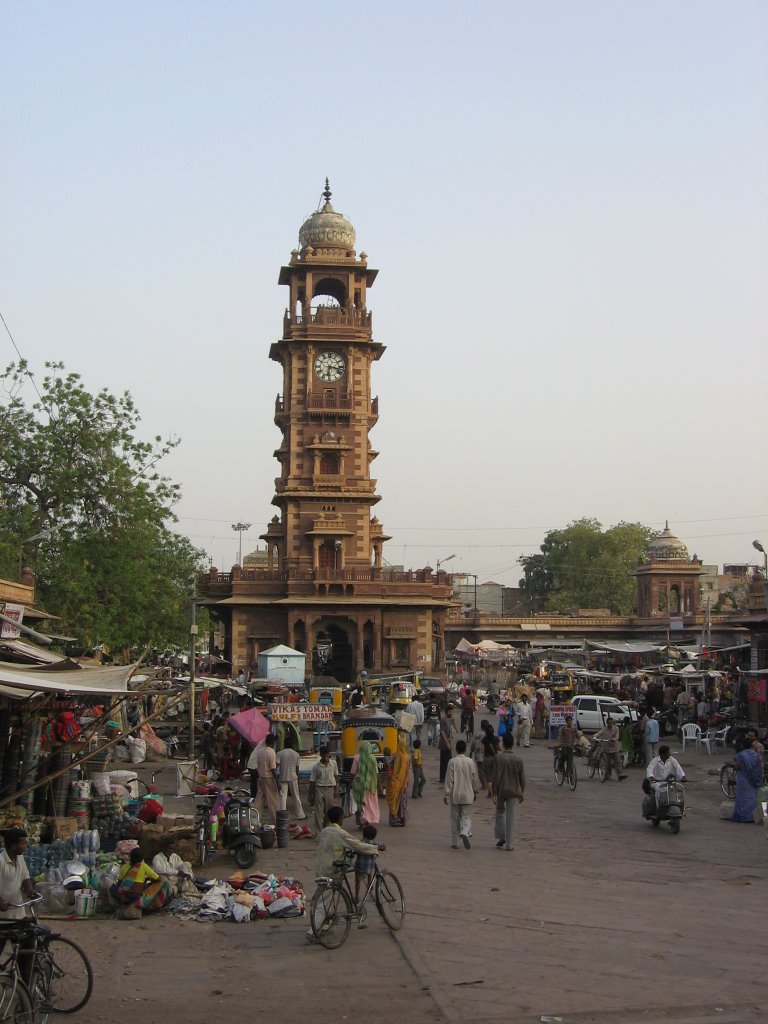 There were tons of shop owners trying to grab my arm and pull me into their shops, but Sam fended them off quickly. I eventually found a store with hand woven table cloths and table runners and bought one for my parents. The young gentleman who owned the store said he had a lot of American buyers. I expressed skepticism as it seemed that Jodhpur was not the hottest tourist destination in India, although I had seen a few tourists staying at my hotel. He said "no no, not tourists, eBay, eBay". He posts the items on eBay, shipping directly from India to the customers in the U.S. "I can make 2-3 times what you paid from eBay shoppers.", he proudly told me. "eBay buyers are the best because they often bid well beyond what we would already charge tourists and other foreign visitors." Other than a few nice fabric stores, the market was mostly for locals, selling fresh vegetables, grains, cooking utensils, etc. We decided to head back to the hotel.
By this time it was 8pm and I was dead tired, not having slept hardly at all the night before thanks to jet lag. They told me to take a shower and get some rest so we could go out to eat around 10pm, but I told them if I took a nap I wouldn't be getting up again, so they laughed and left me alone, agreeing to meet me at 8am sharp the next morning.
To be continued......
Monday, May 22, 2006
Jodhpur - the beginning of the desert
Flying into Jodhpur all one could see below was a see of dark brown sand, interspersed with sparse settlements and the occasional cluster of green trees. Jodhpur is not actually the desert, but sits on the edge of the beginnings of the famous Thar desert of India. Kind of a no man's land between the moderate climes of eastern Rajasthan (the province/state that Jodhpur resides in) and the harsh western desert that borders Pakistan. Flying in kind of reminded me of flying into Las Vegas, where vast reaches of flat scrub land extend for miles before you reach the city.
Jodhpur is not a small town. More than 800,000 people reside in Jodhpur. Like almost all Indian airports, this one too was shared by the military. Soviet style fighter planes and helicopter gunships lay baking in the hot sun on the tarmac. We came in for a smooth landing, much to the relief of the other American passengers, and we taxied to a small 2 story white building with a single entrance. The ramp was thrown down.
"Is this the gate?", I asked Sam.
"No, this is the international airport of Jodhpur." He replied.
"No, I know this is the airport, but is this the gate? I don't see where the airport is."
"You don't understand. That building IS the airport".
This simple airport building, which was quite nice and appeared rather new, was THE international airport of Jodhpur. It had 1 main entrance out front, 1 "gate" to the tarmac, and 1 luggage carousel. Picking up luggage was easy, it was out of the plane and waiting for me by the time I walked into the building. In less than 60 seconds, we were outside and into the car. Hey! This is great, if only all airports were like this!
Travelling in the hot sun in Jodhpur I realized that Delhi was nothing compared to this. While in Delhi the temperature was at least 100 degrees it was a minimum of 115-120 degrees in Jodhpur. While I was pleasantly surprised at the number of thin green leafed trees in and around the city, anywhere there wasn't a tree planted was barren dirt and sand. The buildings, the ground, and the hills were all the color of rust, a deep reddish brown that seemed to reflect the heat back to you in ever greater waves.
Once again, honking was the preferred method of driving. But in Jodhpur we had to share the roads with camels, carts, bicycles, and pedestrians wandering the OPPOSITE direction of traffic in the middle of the road with total disregard for their own safety. Everyone drove too fast and too close together.
As in Delhi, trash was everywhere, only here it was much worse. Jodhpur is fast becoming an "industrial" city, although not the kind of industry you are thinking of, which I will explain later. Due to this, there is a lot of new construction going on and lots of open fields next to new developments. The fields and roads are often plagued by piles of trash left there by God knows who, and once again the desperately poor are living side by side with the rich and middle class. It is a clash of socio-economic levels, but apparently the locals simply accept it.
I had my first taste of Rajasthan Indian food and I must say it was some of the BEST Indian food I had ever tasted. Absolutely amazing. Spicy, full of flavor, and nothing like what I had eaten before in the states. They also often accompany their meals with a cucumber, onion, green pepper salad that was just delicious.
We eventually made it to the hotel and checked in with just enough time to throw down my bags before heading out to work.
To be continued.....
Jodhpur is not a small town. More than 800,000 people reside in Jodhpur. Like almost all Indian airports, this one too was shared by the military. Soviet style fighter planes and helicopter gunships lay baking in the hot sun on the tarmac. We came in for a smooth landing, much to the relief of the other American passengers, and we taxied to a small 2 story white building with a single entrance. The ramp was thrown down.
"Is this the gate?", I asked Sam.
"No, this is the international airport of Jodhpur." He replied.
"No, I know this is the airport, but is this the gate? I don't see where the airport is."
"You don't understand. That building IS the airport".
This simple airport building, which was quite nice and appeared rather new, was THE international airport of Jodhpur. It had 1 main entrance out front, 1 "gate" to the tarmac, and 1 luggage carousel. Picking up luggage was easy, it was out of the plane and waiting for me by the time I walked into the building. In less than 60 seconds, we were outside and into the car. Hey! This is great, if only all airports were like this!
Travelling in the hot sun in Jodhpur I realized that Delhi was nothing compared to this. While in Delhi the temperature was at least 100 degrees it was a minimum of 115-120 degrees in Jodhpur. While I was pleasantly surprised at the number of thin green leafed trees in and around the city, anywhere there wasn't a tree planted was barren dirt and sand. The buildings, the ground, and the hills were all the color of rust, a deep reddish brown that seemed to reflect the heat back to you in ever greater waves.
Once again, honking was the preferred method of driving. But in Jodhpur we had to share the roads with camels, carts, bicycles, and pedestrians wandering the OPPOSITE direction of traffic in the middle of the road with total disregard for their own safety. Everyone drove too fast and too close together.
As in Delhi, trash was everywhere, only here it was much worse. Jodhpur is fast becoming an "industrial" city, although not the kind of industry you are thinking of, which I will explain later. Due to this, there is a lot of new construction going on and lots of open fields next to new developments. The fields and roads are often plagued by piles of trash left there by God knows who, and once again the desperately poor are living side by side with the rich and middle class. It is a clash of socio-economic levels, but apparently the locals simply accept it.
I had my first taste of Rajasthan Indian food and I must say it was some of the BEST Indian food I had ever tasted. Absolutely amazing. Spicy, full of flavor, and nothing like what I had eaten before in the states. They also often accompany their meals with a cucumber, onion, green pepper salad that was just delicious.
We eventually made it to the hotel and checked in with just enough time to throw down my bags before heading out to work.
To be continued.....
Sunday, May 21, 2006
Welcome to Indian Time
The ride to the domestic terminal of Delhi was much like the one from the night before. My friend from my company's Indian agency - let's call him Sam - was quick to point out the parliament building, the US Embassy building, and other key landmarks. The embassy areas are very nice with tree-lined streets and green lawns dividing the road. With the exception of several grown men openly urinating on the walls, it was a pretty sight.
We made it to the airport in one piece, my knuckles white from gripping the door handles. If I thought the international terminal was a mess, I was in for a shock. The domestic terminal was 100 times worse. Again, for a city of over 13 million people, the domestic terminal had only 4 gates and one tiny entrance. The terminal looked like it had been built during the era of the Wright Brothers and was in bad need of repair, decay was everywhere. The sun was out and already it was over 100 degrees. Inside the airport it was marginally better, about 85. We checked in - our airplane tickets were not computerized, the airline issued HAND WRITTEN TICKETS - yes, that's right, hand written. When we got up to the check in desk - more like a badly beaten metal table with a circa 1982 computer on the top - the gentleman very kindly explained that my ticket had been "cancelled". A heated argument ensued between my Indian friend Sam and the airline agent and finally he accepted my ticket. He did not ask for my ID. We went through security. No one asked to see my ID. There was no place to sit down, all the broken and torn waiting seats were occupied. But luckily they boarded quickly enough. We went outside through one of the 4 gates and got into a bus which took us out on the tarmac to our waiting 737-200. The plane was easily 30+ years old. I looked for the manufacturer stamp which is a habit of mine when I enter into airplanes, but it has been wrenched off. Rivets were missing in certain places and the seats were worn and thin. Some of the plastic tray tables were broken. The inside of the plane was unbearable as we were still on the ground, at least 90 degrees. 2 other Americans were on the flight as well and they look terrified. Finally we taxied down the runway where we could see the second runway being built. They actually had women laborers carting sand and concrete in baskets on their heads! These poor women formed a giant chain of labor from the construction area to the supply area. No bulldozers, no forklifts, no machinery of any kind, it appeared that the entire paving of the new runway was being done by manual labor.
We got into position only to be told by the pilot that we were being delayed for 10-15 minutes. Sam smiled grimly and said "welcome to Indian time, where nothing is on time." We sat in the unbearable heat for more than 1 hour. Sweat streamed down my back and soon the entire plane began to smell funky. Finally we took off and the air conditioning was turned on mercifully. We received a warm sandwich (warm from sitting in the heat too long) which I refused to eat, but plenty of delicious fruit juices. The 2 other Americans on the plane kept looking around nervously, wondering if the shuddering plane was going to fall apart. I eventually fell asleep and an hour and a half later we landed.
to be continued......
We made it to the airport in one piece, my knuckles white from gripping the door handles. If I thought the international terminal was a mess, I was in for a shock. The domestic terminal was 100 times worse. Again, for a city of over 13 million people, the domestic terminal had only 4 gates and one tiny entrance. The terminal looked like it had been built during the era of the Wright Brothers and was in bad need of repair, decay was everywhere. The sun was out and already it was over 100 degrees. Inside the airport it was marginally better, about 85. We checked in - our airplane tickets were not computerized, the airline issued HAND WRITTEN TICKETS - yes, that's right, hand written. When we got up to the check in desk - more like a badly beaten metal table with a circa 1982 computer on the top - the gentleman very kindly explained that my ticket had been "cancelled". A heated argument ensued between my Indian friend Sam and the airline agent and finally he accepted my ticket. He did not ask for my ID. We went through security. No one asked to see my ID. There was no place to sit down, all the broken and torn waiting seats were occupied. But luckily they boarded quickly enough. We went outside through one of the 4 gates and got into a bus which took us out on the tarmac to our waiting 737-200. The plane was easily 30+ years old. I looked for the manufacturer stamp which is a habit of mine when I enter into airplanes, but it has been wrenched off. Rivets were missing in certain places and the seats were worn and thin. Some of the plastic tray tables were broken. The inside of the plane was unbearable as we were still on the ground, at least 90 degrees. 2 other Americans were on the flight as well and they look terrified. Finally we taxied down the runway where we could see the second runway being built. They actually had women laborers carting sand and concrete in baskets on their heads! These poor women formed a giant chain of labor from the construction area to the supply area. No bulldozers, no forklifts, no machinery of any kind, it appeared that the entire paving of the new runway was being done by manual labor.
We got into position only to be told by the pilot that we were being delayed for 10-15 minutes. Sam smiled grimly and said "welcome to Indian time, where nothing is on time." We sat in the unbearable heat for more than 1 hour. Sweat streamed down my back and soon the entire plane began to smell funky. Finally we took off and the air conditioning was turned on mercifully. We received a warm sandwich (warm from sitting in the heat too long) which I refused to eat, but plenty of delicious fruit juices. The 2 other Americans on the plane kept looking around nervously, wondering if the shuddering plane was going to fall apart. I eventually fell asleep and an hour and a half later we landed.
to be continued......
It's About Time
Via Yahoo, A quick post on the strong language that the new PM is using against the bombings in Iraq. I really believe that the new government and the work of the coalition forces will do wonders now. I imagine things to begin wrapping up there, though I may be overly optimistic.
good grief what next?
wow, between my compadre's visits to India, my computer's power supply having a meltdown last week, getting it up and running then being laid up with a nasty intestinal virus the next day, to finally feeling better than my new CPU crapping out and leaving windows hanging in the wind(damn you Bill!!), blogging has been far from stellar. My apologies to the loyal readers and visitors to the blog, I'm currently blogging on my wife's university system, as my computer now needs a reformat and re-install, and hopefully the seller will warranty the CPU. Anyone know how to extract the windows files on the hidden partition of an HP Hard drive? anyone?
Welcome to the Third World....
I have been travelling which is one of the reasons for light blogging. I am currently in Indonesia and spent the past week in Western India. This is the first in a series of travelogues which I hope you will find interesting.....
I arrived in Delhi about 9pm off of American Airlines direct flight from Chicago. Immediately coming off the airplane you notice some stark differences from other international airports: the walkway from the aircraft is in poor condition and there are dark stains marking the floors and walls. The international terminal is tiny considering the size of Delhi (13 million+ population) and compared to just about any other airport you have been to. The terminal is supposedly air conditioned, but you could have fooled me as the humidity hits you walking in and the temperature was at least 80 degrees. The bathrooms look like they are 50 years old. Mold stains, broken tile, and dirt spots are everywhere.
The Indian customs agents were extremely friendly and polite and quickly I was on my way to get my luggage. There was no one in the airport but those of us off of the AA flight. I asked one of the Indian passengers from my flight why that was. He said most of the international flights arrive late in the night, around 12-1am, only AA and CO arrive earlier. Once I got my luggage I went out to look for my ride, which had been prearranged. Sure enough, the driver was there with my name on a card.
We walked outside and WHAM! the heat hit me like an open oven. I guess the airport was air conditioned after all! It was humid and hotter than anything I could remember. Even hotter than when I was in Thailand in April 2005, and remember, this is 9pm at night! The air was thick with humidity, exhaust, and pollution from coal fired energy plants. You almost drank the air instead of breathing it. I remember from my travels in Southern China that burning, acrid smell from dirty coal fired energy plants that used to annoy me so much - the same exact smell was here in India, same as I remembered.
They call India a "developing country" but I think that's being a bit over-optimistic. There is extreme poverty everywhere, especially so in the big cities such as Delhi. Entire families, including infants, live on the streets. At every stoplight they rush the cars, banging on the car windows begging for money. You will see large, rich, Indian homes complete with Mercedes Benz and Lexus parked in the driveway and in the empty lot next door will be tents made of plastic garbage bags where the dying poor live. It is a crowded country where the extreme rich and extreme poor live practically on top of each other. While I am sure India has garbage collection services, they either don't get paid much or simply don't work very hard. Trash is everywhere. And I mean everywhere. Not just litter scattered here and there, I am talking mountainous piles of rotting garbage just stacked helter skelter. Sometimes you will see children or the elderly sifting through the piles - in bare feet - collecting scrap pieces of plastic and metal to sell to recyclers. Shiny new building structures stand next to broken decrepit buildings. Welcome to the third world.
The drive to the hotel was terrifying. In India it seems nobody obeys any traffic laws, signals, signs, or even lane dividers. Quite the contrary, as most cars simply straddled 2 lanes. Nobody looks or signals when turning or changing lanes, just flashing lights and horns. Horns, horns, and more horns. Driving anywhere in India is nothing but a cacophony of horns. My skillful driver weaved in and out of traffic, avoiding numerous near collissions and completely ignoring pedestrian rights. He cut through parking lots and gas stations with complete disregard in order to avoid traffic.
Finally we arrived the hotel, fully alert and awake thanks to the insane Delhi traffic. The hotel was beautiful - better be for $200 a night and thank goodness my company paid - and I settled down for a good night's rest before I had to work the next day. Unfortunately, my body was still on USA time and I had a hard time getting to sleep.
I woke up very early, got ready and went downstairs for breakfast. The food was wonderful. Fresh tropical fruits, including mangos, my favorite. Fresh squeezed watermelon juice, different kinds of Indian yogurt, etc. I quickly ate breakfast and checked out of the hotel, waiting for my company's Indian agent to meet me in the lobby. While we had been conversing via e-mail for many months, we had never spoken or met in person before. He was a friendly, but quiet man, all business which I preferred, and we were quickly on our way back to the Delhi airport for our first destination, the desert city of Jodhpur.
I arrived in Delhi about 9pm off of American Airlines direct flight from Chicago. Immediately coming off the airplane you notice some stark differences from other international airports: the walkway from the aircraft is in poor condition and there are dark stains marking the floors and walls. The international terminal is tiny considering the size of Delhi (13 million+ population) and compared to just about any other airport you have been to. The terminal is supposedly air conditioned, but you could have fooled me as the humidity hits you walking in and the temperature was at least 80 degrees. The bathrooms look like they are 50 years old. Mold stains, broken tile, and dirt spots are everywhere.
The Indian customs agents were extremely friendly and polite and quickly I was on my way to get my luggage. There was no one in the airport but those of us off of the AA flight. I asked one of the Indian passengers from my flight why that was. He said most of the international flights arrive late in the night, around 12-1am, only AA and CO arrive earlier. Once I got my luggage I went out to look for my ride, which had been prearranged. Sure enough, the driver was there with my name on a card.
We walked outside and WHAM! the heat hit me like an open oven. I guess the airport was air conditioned after all! It was humid and hotter than anything I could remember. Even hotter than when I was in Thailand in April 2005, and remember, this is 9pm at night! The air was thick with humidity, exhaust, and pollution from coal fired energy plants. You almost drank the air instead of breathing it. I remember from my travels in Southern China that burning, acrid smell from dirty coal fired energy plants that used to annoy me so much - the same exact smell was here in India, same as I remembered.
They call India a "developing country" but I think that's being a bit over-optimistic. There is extreme poverty everywhere, especially so in the big cities such as Delhi. Entire families, including infants, live on the streets. At every stoplight they rush the cars, banging on the car windows begging for money. You will see large, rich, Indian homes complete with Mercedes Benz and Lexus parked in the driveway and in the empty lot next door will be tents made of plastic garbage bags where the dying poor live. It is a crowded country where the extreme rich and extreme poor live practically on top of each other. While I am sure India has garbage collection services, they either don't get paid much or simply don't work very hard. Trash is everywhere. And I mean everywhere. Not just litter scattered here and there, I am talking mountainous piles of rotting garbage just stacked helter skelter. Sometimes you will see children or the elderly sifting through the piles - in bare feet - collecting scrap pieces of plastic and metal to sell to recyclers. Shiny new building structures stand next to broken decrepit buildings. Welcome to the third world.
The drive to the hotel was terrifying. In India it seems nobody obeys any traffic laws, signals, signs, or even lane dividers. Quite the contrary, as most cars simply straddled 2 lanes. Nobody looks or signals when turning or changing lanes, just flashing lights and horns. Horns, horns, and more horns. Driving anywhere in India is nothing but a cacophony of horns. My skillful driver weaved in and out of traffic, avoiding numerous near collissions and completely ignoring pedestrian rights. He cut through parking lots and gas stations with complete disregard in order to avoid traffic.
Finally we arrived the hotel, fully alert and awake thanks to the insane Delhi traffic. The hotel was beautiful - better be for $200 a night and thank goodness my company paid - and I settled down for a good night's rest before I had to work the next day. Unfortunately, my body was still on USA time and I had a hard time getting to sleep.
I woke up very early, got ready and went downstairs for breakfast. The food was wonderful. Fresh tropical fruits, including mangos, my favorite. Fresh squeezed watermelon juice, different kinds of Indian yogurt, etc. I quickly ate breakfast and checked out of the hotel, waiting for my company's Indian agent to meet me in the lobby. While we had been conversing via e-mail for many months, we had never spoken or met in person before. He was a friendly, but quiet man, all business which I preferred, and we were quickly on our way back to the Delhi airport for our first destination, the desert city of Jodhpur.
Sunday, May 07, 2006
Joyyyyy
Got this for my birthday from the inlaws, a very good joystick for the money, if you go to the right places (i.e. not mainstream computer suppliers with stores(translation:Tigerdirect)), good response, and made my flying in Battlefield 2 much much better, once I relearned how to fly without a mouse.
Socialized Health Care
A linky from my counterpart, who, like I, has been rather busy. Regarding socialized medicine. Socialized medicine isn't good because it tries to guarantee too many things to too many people, and everyone loses. It simply institutes government power in places where it never should be, which is in the private, quiet lives of everyone in the sphere of control. You can't escape it when there's this much. Anyways, watch the video for more info. 56Kers beware.
Sunday, April 30, 2006
Anti-Social
Here in Britain if they have a thing called "ant-social behavior orders", or ASBOs for short. Basically what they are is if you are a nuisance in some way or basically you get complained about you get one f these, more or less a restraining order, but far looser in the way they give them out. I'm against them being used at all, because it's obviously an admittance that the British have too few police and can't keep things under control so they do these to make it look like something's being done. Additionally, they can be abused so very easily. Well, here's the case of abuse. Yikes and Yikes
Thursday, April 27, 2006
What in the World is Going on in British Politics?
My apologies for the delayed posts, but hopefully this one will more than make up for it.
It seems that maybe (hopefully) new Labour, the British ruling party at the moment, may be in the proverbial foul smelling creek without means of propulsion. With the NHS (National Health Service) in crisis, and in many cases rationing care, criminals being released instead of deported due to their immigration status, and now the Deputy Prime Minister has revealed he's been sleeping with his secretary. To be fair, the affair ended in 2004, but not after going on for 2 years, which started at a work Christmas party (does anyone else besides me think that those things re nothing but trouble?).
Firstly, we have the NHS, which is in deep trouble now, completely out of cash. This is a real problem, that could impact the lives of millions. Anyone else out there think that having such a massive government program closely linked to the very life of its people is a bad idea? This is why I am so opposed to the idea of a nationalized health care system. Not because I want to deny people the chance to live a long and healthy life, but because everyone loses. The government loses badly needed funds for other uses, the people get poor coverage (my wife has been dealing with an illness going on 4 years now that has finally been diagnosed, and is still taking months to get treatment for, and the treatment is a prescription), and the workers get taxed heavily. Furthermore, I get so sick of hearing the excuse: "that it's free" Is that why I pay a huge amount of my income to the NHS? Far more than my insurance premium was when I worked in California? And I get poorer service? The response by the health secretary to try and deal with the issue of nursing shortages was so terse she was booed off stage. Seems like Blair picked a winner there.
Secondly, it's also emerged that 1,023 criminals were released from prison, including rapists, murderers, and pedophiles, and instead of deporting them, it let them roam free. Where are they now? Nobody knows. That's what's scary. Where Britain is already reeling with serious crime issues, mounting teenage crime rates, and police hamstrung by PC policies and paperwork, and the citizens hamstrung by an inability to defend themselves, the criminals have a very serious and deadly advantage. Then this happens. Seems like we've got a great home secretary who's got things under control.
Thirdly, we have the Deputy Prime Minister, basically the VP, sleeping with his secretary for 2 years. Now, I know that's probably not a huge revelation, as it seems to happen everyday, and hey our own Presidents have done it. The thing that concerns me is that he most likely was on the job when some or many of their goings on happened. A CEO would get fired for something like that. That's where I get annoyed, when it happens when we're supposed to be worrying about the running of the country.
So, it seems Blair can really pick 'em. Now, Blair, while I never really liked the guy, has generally got a very impressive ability to spin things on its head when he needs to. He hasn't said much that's impressed me this time, adding that the last time government had such a massive failure, people had 'lost homes and jobs", in reference to the economic failures that happened in 1992 under the conservative watch. Ok, Mr. Blair, true, but when I'm reading that murderers and rapists are leaving our prisons instead of being deported, I'm watching my wife suffer while she waits to get evaluated for her prescription, (something that should take a week or two, not months), and I watched my Wife's grandfather die prematurely because of simple errors made at the hospital because someone couldn't be bothered to look at a damn X-Ray. We're dealing with far more than jobs and homes, we're dealing with life and death. I'm sorry Tony, but the time has come for you to either dump your ministers and get things taken care of properly, quickly, and without the added cost to the taxpayer, or step aside. The nation of Great Britain has gone further and further downhill, and you have appointed bungling morons to do the job of running the country. You may not have created all the messes yourself, but good grief man, you're supposed to at least make them better, not worse and make more. Bring the Great back in to Great Britain.
It seems that maybe (hopefully) new Labour, the British ruling party at the moment, may be in the proverbial foul smelling creek without means of propulsion. With the NHS (National Health Service) in crisis, and in many cases rationing care, criminals being released instead of deported due to their immigration status, and now the Deputy Prime Minister has revealed he's been sleeping with his secretary. To be fair, the affair ended in 2004, but not after going on for 2 years, which started at a work Christmas party (does anyone else besides me think that those things re nothing but trouble?).
Firstly, we have the NHS, which is in deep trouble now, completely out of cash. This is a real problem, that could impact the lives of millions. Anyone else out there think that having such a massive government program closely linked to the very life of its people is a bad idea? This is why I am so opposed to the idea of a nationalized health care system. Not because I want to deny people the chance to live a long and healthy life, but because everyone loses. The government loses badly needed funds for other uses, the people get poor coverage (my wife has been dealing with an illness going on 4 years now that has finally been diagnosed, and is still taking months to get treatment for, and the treatment is a prescription), and the workers get taxed heavily. Furthermore, I get so sick of hearing the excuse: "that it's free" Is that why I pay a huge amount of my income to the NHS? Far more than my insurance premium was when I worked in California? And I get poorer service? The response by the health secretary to try and deal with the issue of nursing shortages was so terse she was booed off stage. Seems like Blair picked a winner there.
Secondly, it's also emerged that 1,023 criminals were released from prison, including rapists, murderers, and pedophiles, and instead of deporting them, it let them roam free. Where are they now? Nobody knows. That's what's scary. Where Britain is already reeling with serious crime issues, mounting teenage crime rates, and police hamstrung by PC policies and paperwork, and the citizens hamstrung by an inability to defend themselves, the criminals have a very serious and deadly advantage. Then this happens. Seems like we've got a great home secretary who's got things under control.
Thirdly, we have the Deputy Prime Minister, basically the VP, sleeping with his secretary for 2 years. Now, I know that's probably not a huge revelation, as it seems to happen everyday, and hey our own Presidents have done it. The thing that concerns me is that he most likely was on the job when some or many of their goings on happened. A CEO would get fired for something like that. That's where I get annoyed, when it happens when we're supposed to be worrying about the running of the country.
So, it seems Blair can really pick 'em. Now, Blair, while I never really liked the guy, has generally got a very impressive ability to spin things on its head when he needs to. He hasn't said much that's impressed me this time, adding that the last time government had such a massive failure, people had 'lost homes and jobs", in reference to the economic failures that happened in 1992 under the conservative watch. Ok, Mr. Blair, true, but when I'm reading that murderers and rapists are leaving our prisons instead of being deported, I'm watching my wife suffer while she waits to get evaluated for her prescription, (something that should take a week or two, not months), and I watched my Wife's grandfather die prematurely because of simple errors made at the hospital because someone couldn't be bothered to look at a damn X-Ray. We're dealing with far more than jobs and homes, we're dealing with life and death. I'm sorry Tony, but the time has come for you to either dump your ministers and get things taken care of properly, quickly, and without the added cost to the taxpayer, or step aside. The nation of Great Britain has gone further and further downhill, and you have appointed bungling morons to do the job of running the country. You may not have created all the messes yourself, but good grief man, you're supposed to at least make them better, not worse and make more. Bring the Great back in to Great Britain.
Saturday, April 22, 2006
Shell casing stamps? Let's get real
Found this this morning, seems that the glorious state of California has come up with a new way of combating gun crime. The premise behind it is that when the weapon is fired, it makes a mark on the casing that will identify the gun. The write doesn't go into detail on what the marking is, but say that it will identify the make and model, but if it's going to be attached to a statewide database then it will most likely be serial number as well.
Let's think about this in reality though. I disagree with the inventor's position that the firing pin is unalterable, number 1: where there's a will there's a way, up to and including swapping out the firing pin to an unmarked one, it won't take a brain surgeon to figure out how to make that part. A few points of the article:
"All it takes is a few swipes (on the pin) with a sandpaper or nail file, and (the marker) is gone," he said."
If the pin is indeed hard as diamond, it will take more than a few swipes, but probably not much more than that.
"He called the technology "laughable," saying trigger-happy criminals could outwit police investigators by picking up spent shells at a shooting range and sprinkling them at a crime scene."
Disagree, no guy who just sprayed a few bodies with about 10 rounds a piece are going to stop when they're done, pick up their shells, drop a few other shells on the ground then speed off into the darkening night. When a firearm goes off, you hear it, people look out their windows, and call the cops. They know that and aren't going to waste time.
Nearly 1,800 Californians lost their lives to gun violence in 2004, according to the state Department of Justice. But police make arrests in only 55 percent of homicides due to the lack of sufficient evidence.
The question is, what evidence is lacking? The author doesn't make that clear, letting the reader think that it's the lack of gun evidence. Evidence can be many things, and in my understanding, are only loosely related to identifying the gun's serial number. We came up with serial number and ownership databases for the same reason, and while it has helped, all the lawbreakers did was file off the serial number or buy guns off the black market.
"I question people who opposed something so straightforward," said Griffin Dix, California state council president of the Million Mom March. "You can put an identifying number on every container of yogurt you sell, but not on a gun?"
I get rather frustrated at people who phrase their viewpoints this way, attempting to take the moral high ground in a debate like this. Like the greenies who ask regarding poor environmental legislation: "I questions x's stance on why he doesn't want our future generation to not have to breathe through a mask all the time", All law abiding citizens would love to stamp out crime, especially crime that takes the life of another human being, but the point being, criminals act outside the law, hence the term criminals. They're not gonna go out and buy the latest gun because they wanna go out and shoot someone. They're gonna go to the black market where guns are sold and bought under the radar, not to Tom's Gun and Ice Cream Shoppe. Also, just to be picky, every gun has an ID number on it Griffin, it's called a SERIAL NUMBER.
In wrap up, I don't necessarily disagree with the law requiring ID's stamped on every shell that a gun spits out, just don't think it's going to do any good, and if it won't then why in the world do we waste our time with poor legislation to put on our books? We've got serious issues to deal with, and worrying about putting a stamp on a shell casing is a little lower on the list than others.
Let's think about this in reality though. I disagree with the inventor's position that the firing pin is unalterable, number 1: where there's a will there's a way, up to and including swapping out the firing pin to an unmarked one, it won't take a brain surgeon to figure out how to make that part. A few points of the article:
"All it takes is a few swipes (on the pin) with a sandpaper or nail file, and (the marker) is gone," he said."
If the pin is indeed hard as diamond, it will take more than a few swipes, but probably not much more than that.
"He called the technology "laughable," saying trigger-happy criminals could outwit police investigators by picking up spent shells at a shooting range and sprinkling them at a crime scene."
Disagree, no guy who just sprayed a few bodies with about 10 rounds a piece are going to stop when they're done, pick up their shells, drop a few other shells on the ground then speed off into the darkening night. When a firearm goes off, you hear it, people look out their windows, and call the cops. They know that and aren't going to waste time.
Nearly 1,800 Californians lost their lives to gun violence in 2004, according to the state Department of Justice. But police make arrests in only 55 percent of homicides due to the lack of sufficient evidence.
The question is, what evidence is lacking? The author doesn't make that clear, letting the reader think that it's the lack of gun evidence. Evidence can be many things, and in my understanding, are only loosely related to identifying the gun's serial number. We came up with serial number and ownership databases for the same reason, and while it has helped, all the lawbreakers did was file off the serial number or buy guns off the black market.
"I question people who opposed something so straightforward," said Griffin Dix, California state council president of the Million Mom March. "You can put an identifying number on every container of yogurt you sell, but not on a gun?"
I get rather frustrated at people who phrase their viewpoints this way, attempting to take the moral high ground in a debate like this. Like the greenies who ask regarding poor environmental legislation: "I questions x's stance on why he doesn't want our future generation to not have to breathe through a mask all the time", All law abiding citizens would love to stamp out crime, especially crime that takes the life of another human being, but the point being, criminals act outside the law, hence the term criminals. They're not gonna go out and buy the latest gun because they wanna go out and shoot someone. They're gonna go to the black market where guns are sold and bought under the radar, not to Tom's Gun and Ice Cream Shoppe. Also, just to be picky, every gun has an ID number on it Griffin, it's called a SERIAL NUMBER.
In wrap up, I don't necessarily disagree with the law requiring ID's stamped on every shell that a gun spits out, just don't think it's going to do any good, and if it won't then why in the world do we waste our time with poor legislation to put on our books? We've got serious issues to deal with, and worrying about putting a stamp on a shell casing is a little lower on the list than others.
Friday, April 21, 2006
United Iraqi Alliance nominates new candidate
For those of you who don't know, embattled UIA candidate al-Jafaari is out and the new guy is Jawad al-Maliki:
Maliki hails from the Dawa Party, the same branch of the UIA that Jaafari is from. The two are close allies and Maliki no doubt holds the same sectarian edges that made Jaafari an undesirable candidate. While there is still no comment from the other blocs, I would not be surprised if they rejected the idea of a near clone candidate. The candidate most acceptable to the other blocs, Adil Abdul-Mahdi, came from the other UIA’s other large party, the SCIRI.
As Omar posted before this decision was reached, this decision seems aimed more at keeping the unity of the UIA than it is at keeping the unity of Iraq. Even months ago independent politicians were breaking away from the UIA’s party line, saying that a Jaafari candidacy was no longer acceptable. The chorus has grown dramatically in recent weeks. Reaching a new consensus on a new candidate, especially after Jaafari won due to a single vote by the controversial Sadrists, is meant to hold them together more than chang their position. The face has changed, but not the message.
Via Publius Pundit. It will be interesting to see if the Sunni and Kurdish political parties accept the UIA's new nomination or not, especially if Maliki isn't much different than al-Jafaari.
Do As I Say (Not as I Do) : Profiles in Liberal Hypocrisy
That's the title of a recent book by author Peter Schweizer of the Hoover Institution. I'll save my own judgement for after I read it, but here's a detailed review you can read now. Excerpt:
Schweizer looks at a number of contemporary icons of the American left, with an eye to detecting hypocrisy. Among his subjects are Noam Chomsky, Michael Moore, Al Franken, Ted Kennedy, Hillary Clinton, Ralph Nader, Nancy Pelosi, George Soros, Barbra Streisand, Gloria Steinem, and Cornel West. He finds in each case a private life markedly at variance with the public persona.
Now, one has to be careful when playing the ad hominem game. A person's intellectual claims are not disproved by his bad character. Commendably, Schweizer doesn't attempt to discredit these pestiferous statists by looking for sexual peccadilloes or substance abuse issues. Instead, he focuses on their financial lives, which seem to me fairer game. To hear John Kerry bash the "rich" for not paying their fair share in taxes, and then to find out that he and his wife (worth $700 million) pay less than 15% of their own income in taxes, or to hear Katrina vanden Heuval denounce efforts to end the inheritance tax, and then discover that she herself is a multimillionaire heiress, is to face a serious question. Granted, as a matter of logic, that their hypocrisy doesn't disprove the principles they espouse, still, which principle should the listener adopt, the one espoused or the one embodied in the speaker's life?
It's also wise to remember that hypocrisy exists on both sides of the political isle. But it seems to me that the MSM tends to magnify incidents on the right while ignoring or glossing over those on the left, leaving it up to the "vast, right-wing conspiracy" of blogs, talk radio, and independent journalists to pick up the slack.
Big hat tip to one of my favorite blogs, Samizdata, for the link and info.
Thursday, April 20, 2006
Smuggling my way out of Iraq
Final installment of Michael Totten's road trip to Iraq from Turkey. Great stuff.
On the dark empty highway an armed Turkish military patrol pulled us off to the side of the road. We were never stopped on our way into Turkish Kurdistan. On the way out, though, the army wanted to know who everyone was and what they were doing.
I pulled the car over. Soldiers bearing rifles completely surrounded us. I rolled down the driver’s side window and reached for my passport. A uniformed officer barked something at me in Turkish. I didn’t understand any of it.
“Hello!” I said. “Do you speak English?”
He jerked his head backward, clearly startled, squinted his eyes, and said something else to me in Turkish.
All the soldiers wore deadly serious facial expressions and held their rifles ramrod straight across their chests. We could have been terrorists or gun-runners for the PKK, and they were not messing around.
UN-believable
Via Winds of Change (can you tell I'm reading them right now?):
THIS, folks, is the United Nations at work. So sorry if you're one one of the millions killed or ensalved over the years by Sudan's Arab government - because "The Global Test" thinks capital punishment is just fine for BWB (Breathing While Black). At least, it's fine as long as it's carried out by approved regimes with a UN License to Kill® - which is to say, any Arab or Muslim nation, or anyone with the approved backing of Russia or China.
Yeah, these are the people the US should seek approval from for all war and peace decisions in its foreign policy.
Thursday's Winds of War is up
...over at Winds of Change. Read the whole thing for an excellent round up of the global war on terror.
Subscribe to:
Posts (Atom)
